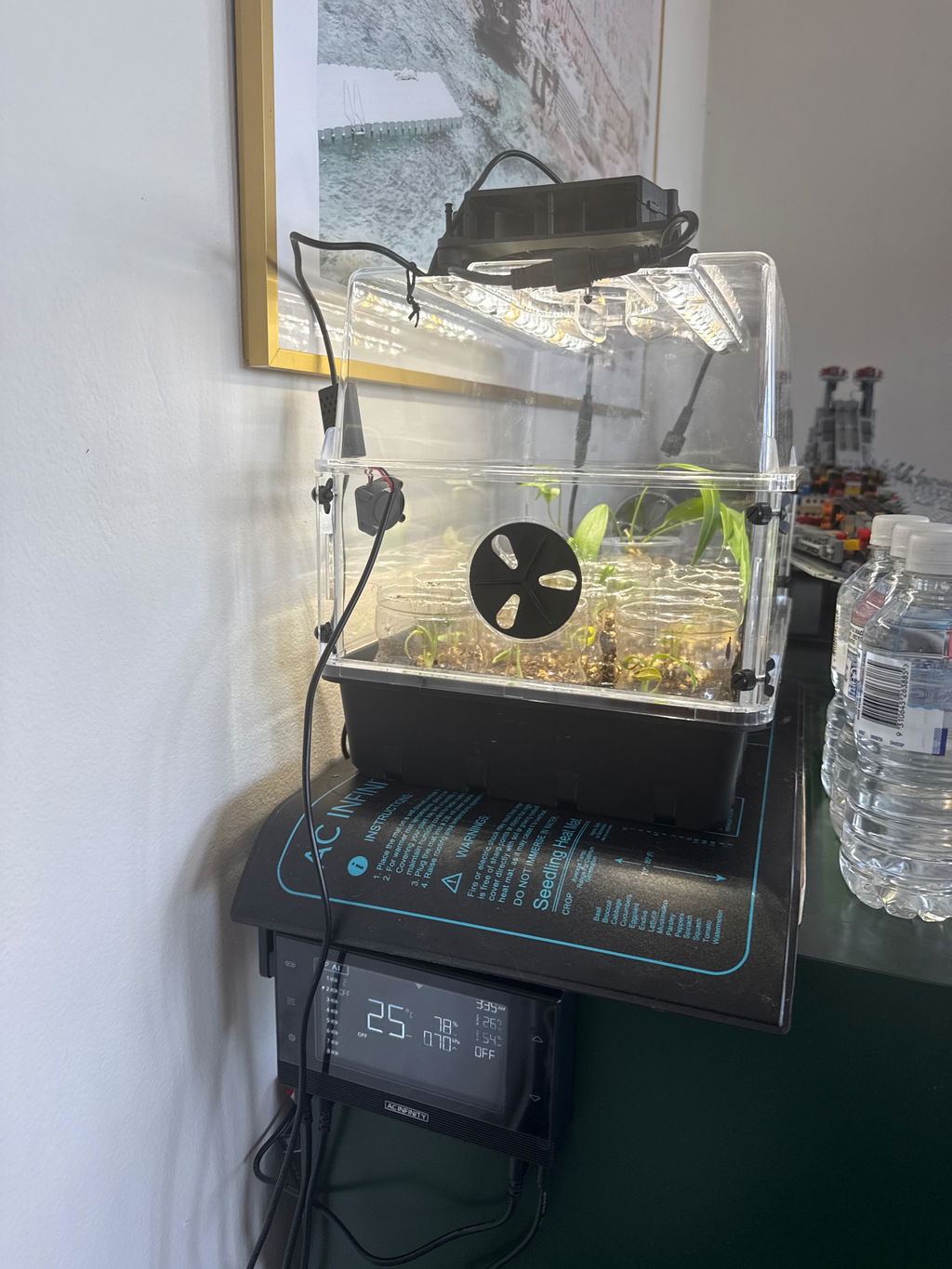
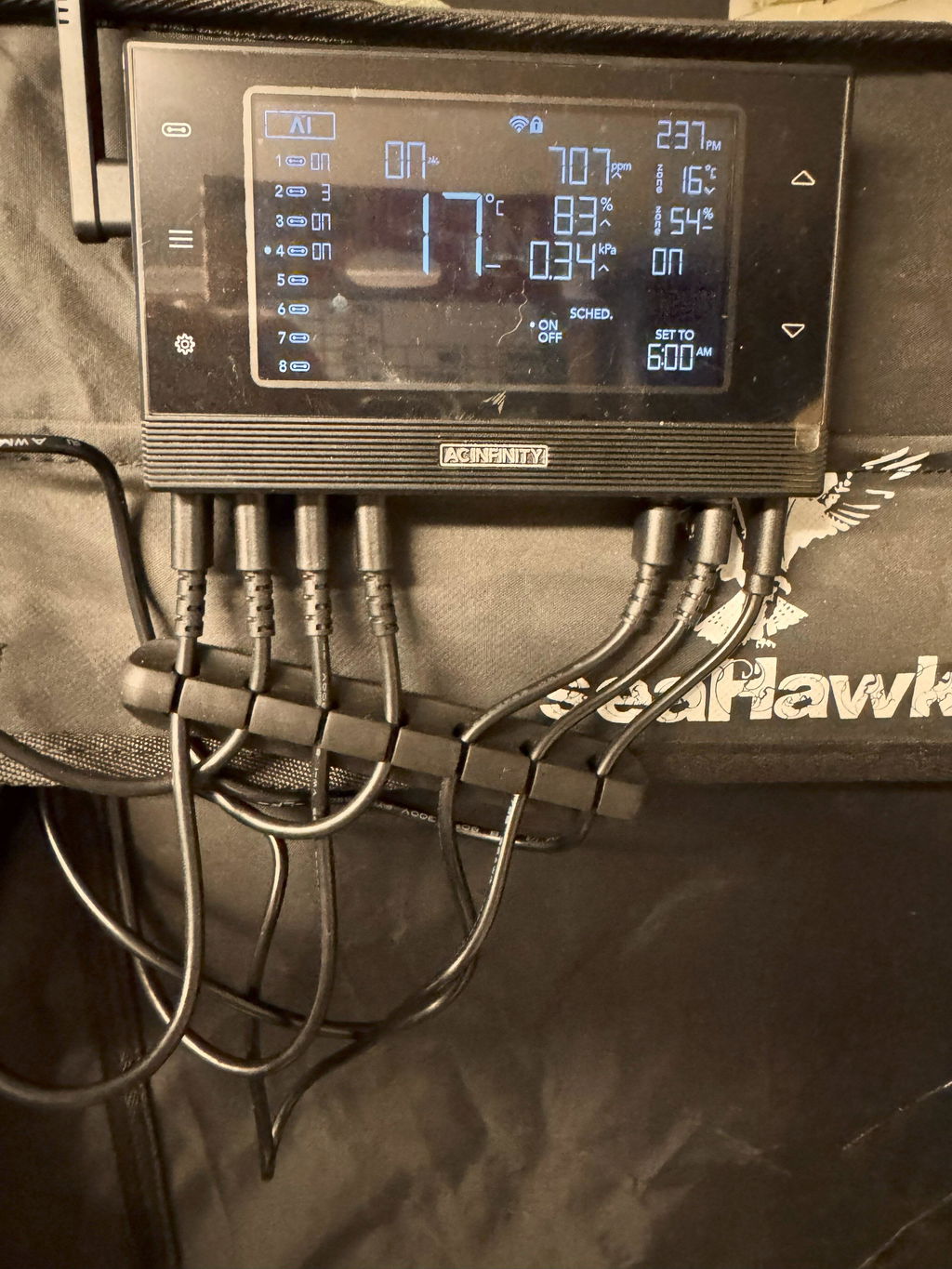
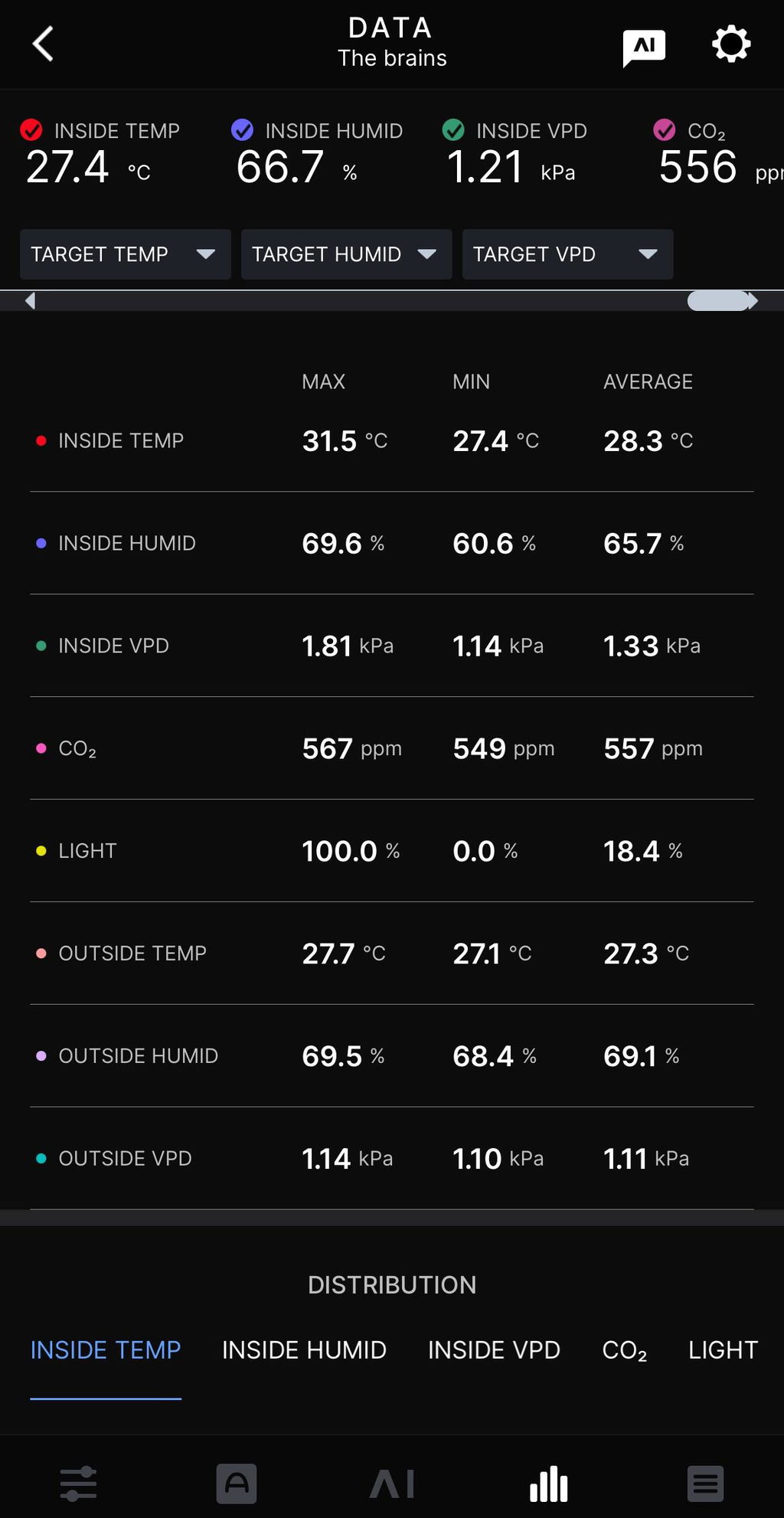
The AC Infinity Controller AI+ is an eight-port environmental controller that works out its own output levels instead of waiting for you to tune them. It reads temperature, humidity and VPD across two independent zones, learns how your space responds, and adjusts fans, lights, humidifiers and heaters to hold target without the overshoot-and-correct swing you get from plain on/off triggers. It is the top of the current AC Infinity controller range and the only one that takes add-on sensors.
Dynamic output, not just triggers
A trigger-based controller knows two things: above target and below target. It runs the fan flat out until the number crosses the line, then stops. The Controller AI+ instead sets the level it expects to need — 40% rather than 100% — based on how your room has actually behaved, and corrects from there. In practice that means a steadier line on the chart, less hunting, and equipment that is not permanently slamming between off and maximum.
You choose how much of that it does. Beginner mode takes the whole job: tell the app what you are growing and what devices you have and it builds the programs. Advanced mode gives you every trigger, timer, cycle, schedule, minimum and maximum level by hand, with the AI adjusting within the bounds you set. Programs live on the controller itself, so a dropped WiFi connection or a power cut does not stop your room running.
Two zones and expandable sensors
The onboard sensor plus the included 3.66 m (12 ft) probe give you two separate climate readings, and the eight ports can be split across them. One tent in flower and one in veg, or a tent and the lung room around it, run their own programs from one unit. Two more sensor ports take the CO₂ + Light, soil, hydro, water or an extra climate sensor — so the controller you buy now covers things you have not bought yet.
It also has its own power adapter. That sounds minor until you compare it with the Controller 69 Pro, which draws power through the device it is plugged into and cannot run on its own.
Turn it into a WiFi CO₂ controller
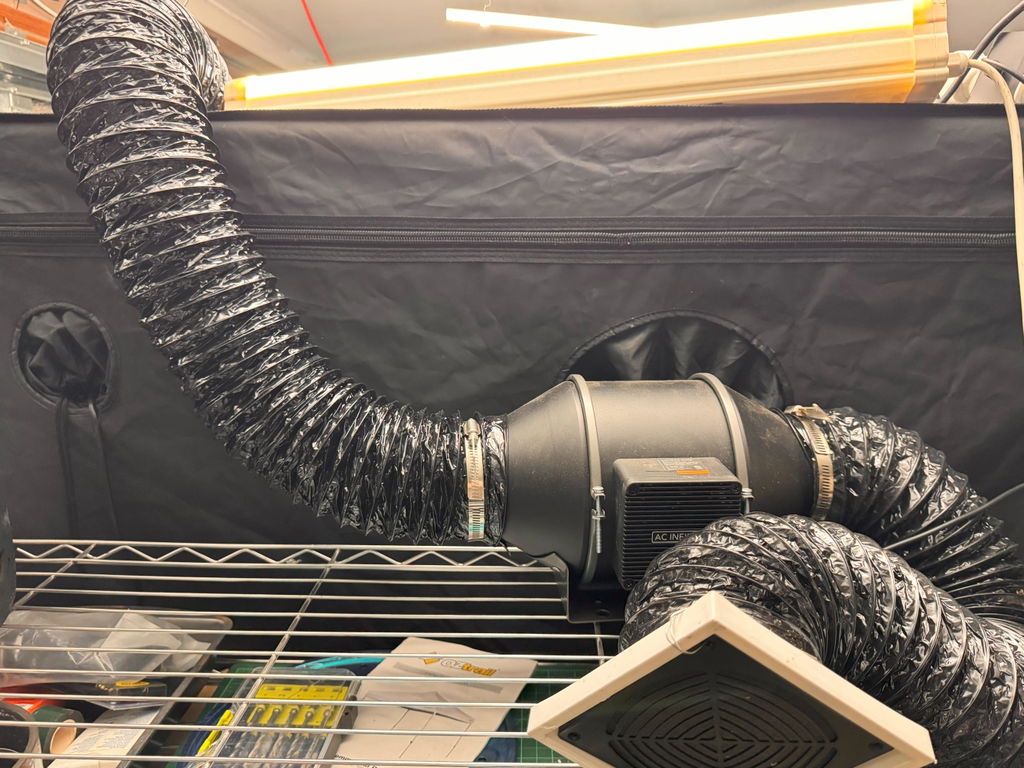
This is the setup we run ourselves, and it is the one most people never hear about. Add the CO₂ + Light Sensor to a sensor port, plug a UIS Control Plug into a device port, and put a CO₂ regulator and solenoid into the control plug. The Controller AI+ now reads CO₂ in parts per million and switches the solenoid on and off to hold your target — and because the same controller also runs your extraction fan, it can stop dumping the CO₂ you just paid for straight out the duct.
A standalone CO₂ controller does one job and costs a great deal more. This does the same job inside the system already running your fans, lights, humidifier and heater, with the readings, history and alerts in the same app. Both the control plug and the regulator we stock are fitted with Australian plugs, so nothing here needs an adapter.
Specifications
| Product identification | |
| Manufacturer | AC Infinity Inc. |
| Product name | CONTROLLER AI+ |
| Model | CTR89Q |
| UPC | 819137024403 |
| Dimensions and display | |
| Total dimensions | 14.9 × 8.7 × 2.4 cm (5.8 × 3.42 × 0.94 in) |
| Display size | 11.4 cm (4.5 in) |
| Sensor probe length | 3.66 m (12 ft) |
| Performance and technical | |
| Device ports | 8, independently programmed |
| Maximum devices controlled | 8 direct, up to 32 using splitter hubs |
| Zones | 2 independent |
| Sensors supported | 3 (1 built in, 2 ports) |
| Onboard and corded sensors | Temperature, humidity, VPD |
| Controls | Capacitive touch |
| Power source | Own power adapter (included) |
| Input voltage | 100–240 V AC |
| Wattage | 2 W maximum |
| App connection | WiFi (2.4 GHz) and Bluetooth |
| Operating temperature | 0–60 °C (32–140 °F) |
| Operating humidity | 35–85% RH |
| Documentation | |
| Quick start guide | |
FAQ
Is it worth the step up from the 69 Pro+?
They have the same eight ports, so ports are not what you are paying for. The difference is the second zone, the two sensor ports and the dynamic output. If you run one space with four or five devices and you are happy setting triggers yourself, the 69 Pro+ does that well. If you run two spaces, want CO₂ or soil or water sensing, or would rather not spend the next month tuning percentages, the AI+ is the one with room to grow.
How many devices can I actually connect?
Eight directly, each with its own program. A 4-port splitter hub takes one port up to four devices that share that port's single program — ideal for a bank of matched clip fans — which is how the 32-device figure is reached. One catch specific to this controller: a device on a hub loses its device-specific functions, such as clip-fan oscillation. Anything that needs its own behaviour goes on its own port.
Do I need the app?
No. Every program runs on the controller and survives a dropped connection. The app adds remote access, push alerts, historical charts, CSV export and the AI presets, which is most of why people buy this controller rather than a 69 — but the room keeps running without it.
Can it control gear that isn't AC Infinity?
Yes, two ways. A UIS Control Plug switches any outlet-powered device that starts by itself when it gets power — air conditioners, dehumidifiers, CO₂ solenoids, pumps. Dimmable LED drivers connect through a Type-A, Type-B or Type-D lighting adapter for full ramping and scheduling. Devices with a physical power button that must be pressed each time are the exception; the plug cannot press it for you.
Can I add more than two extra sensors?
Not at the moment. The controller supports three sensors — the built-in one plus two ports — and there is no sensor splitter available yet. Pick the two that matter most for your setup; the standard UIS 4-port splitter hub works on device ports only and will not expand sensors.
Will it work with my existing AC Infinity gear?
If it has a UIS port, yes — Cloudline inline fans, Cloudray clip fans, Cloudlift floor fans, Airlift shutter fans, Cloudforge humidifiers, Hydrone dehumidifiers, Thermoforge heaters, Ionboard, Ionbeam, Iongrid and Ionframe lights. That compatibility is the whole point of the platform: the controller outlasts the devices.