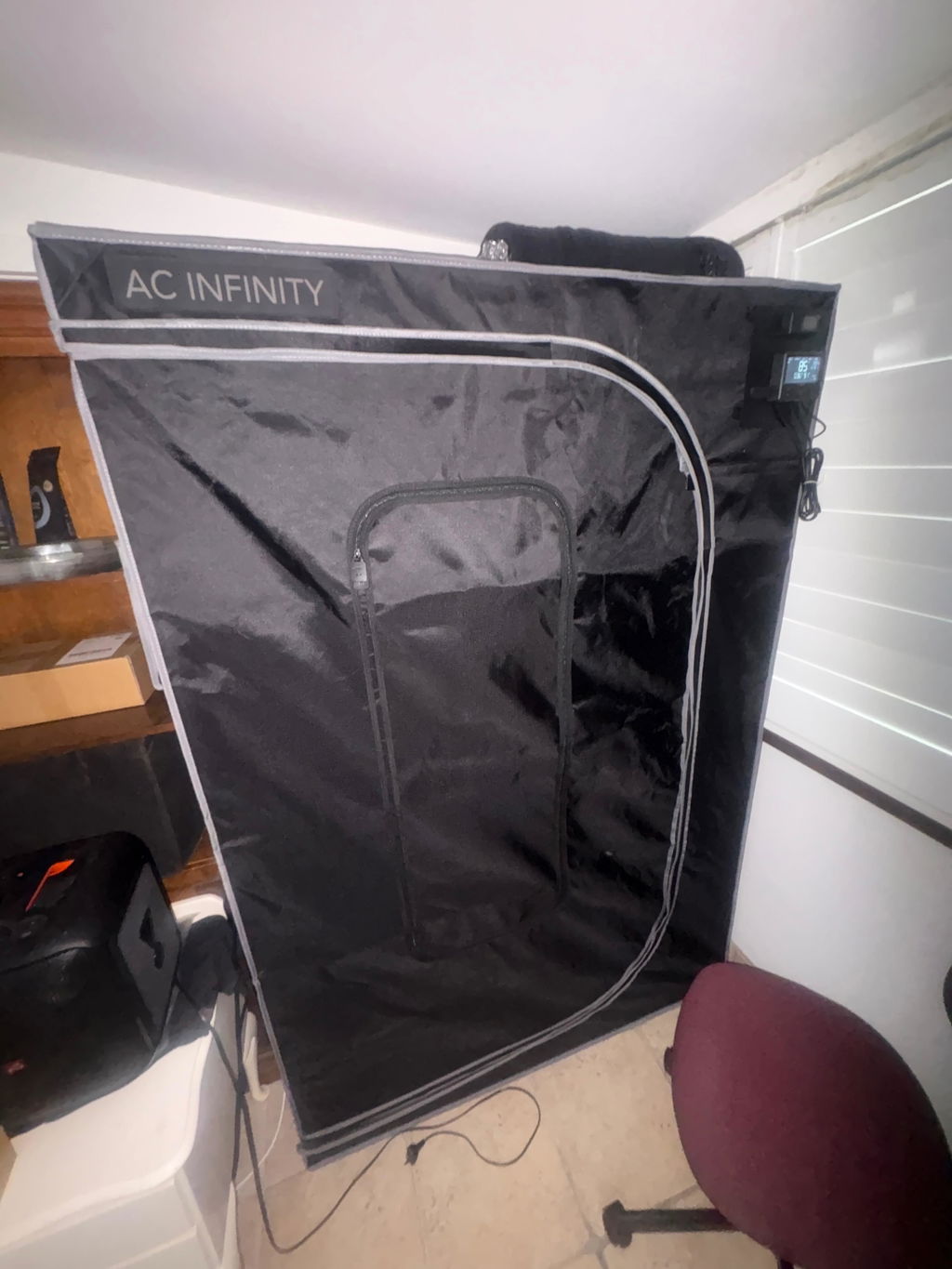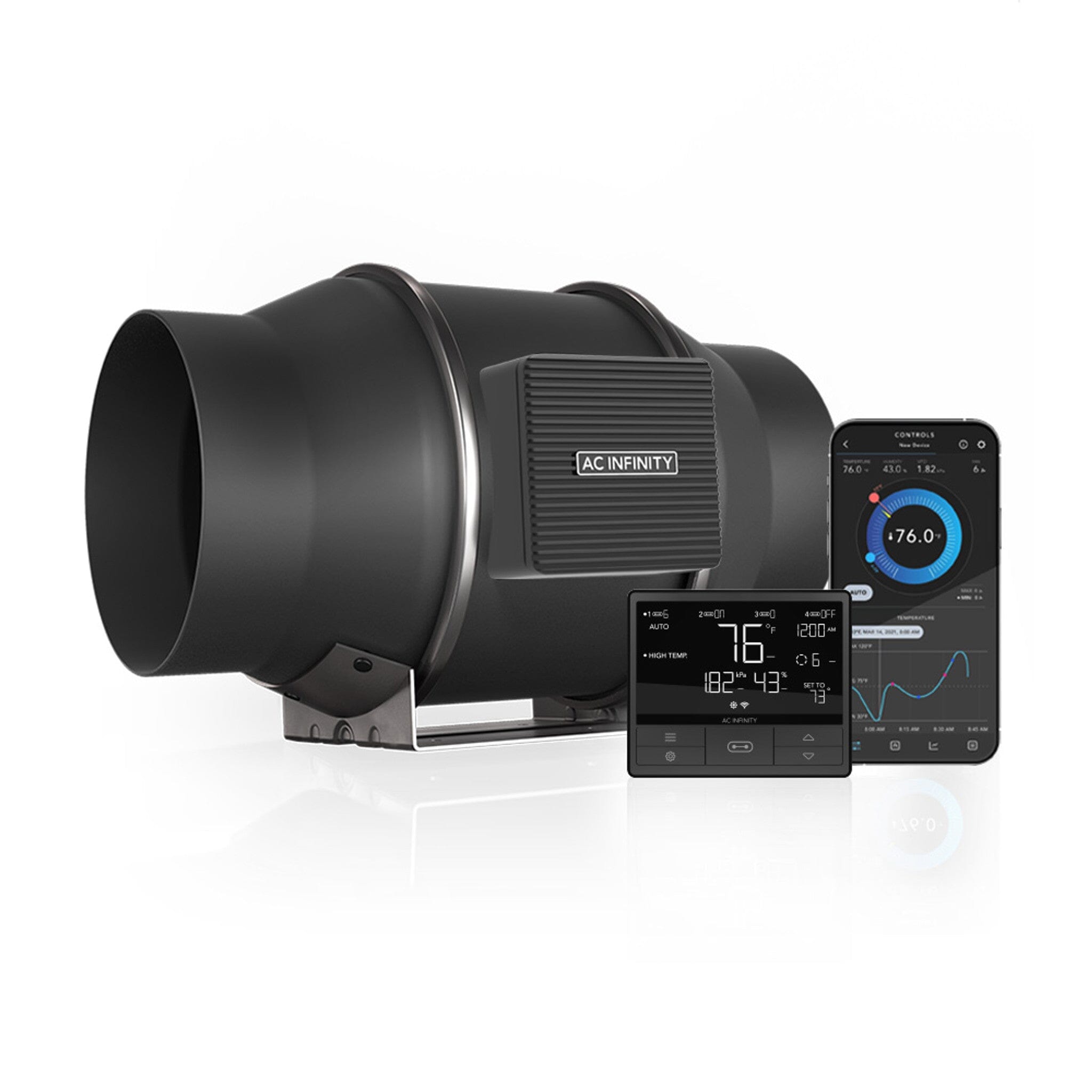
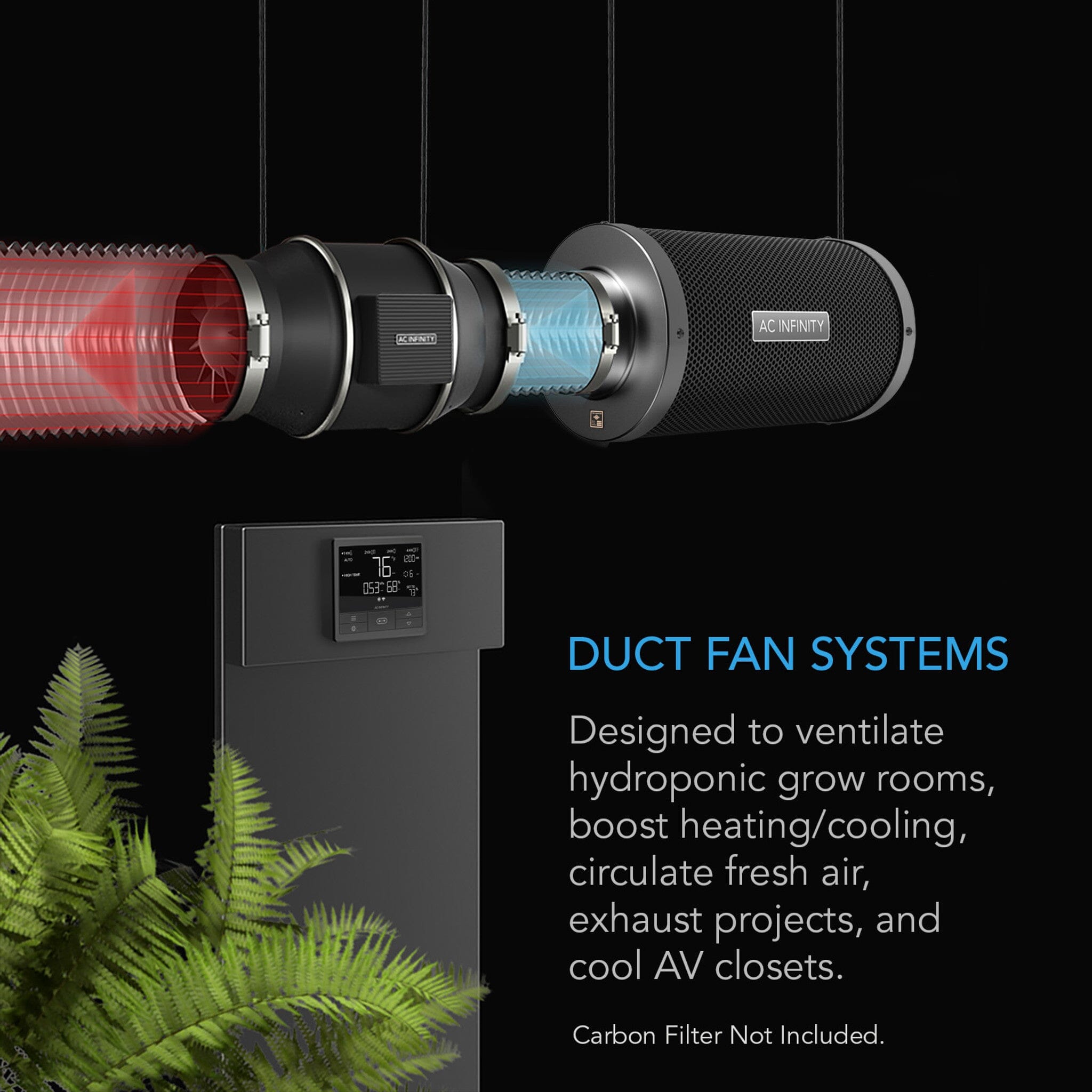


The AC Infinity CLOUDLINE PRO T6 is a 150 mm (6″) smart inline duct fan built to move serious air quietly — 722 m³/h · 201 L/s (425 CFM) through filters, bends and long duct runs without the drone of a traditional AC-motor fan. A mixed-flow impeller and PWM-controlled EC motor hold airflow up where cheaper fans stall, and the included Controller 69 Pro turns it into a set-and-forget climate system: temperature, humidity and VPD triggers, dynamic speed, timers, schedules and full WiFi app control. It's the fan we sell most for 1.2 × 1.2 m (4×4) tents, and it does the same job in a subfloor, attic, garage or AV cupboard.
Smart climate control
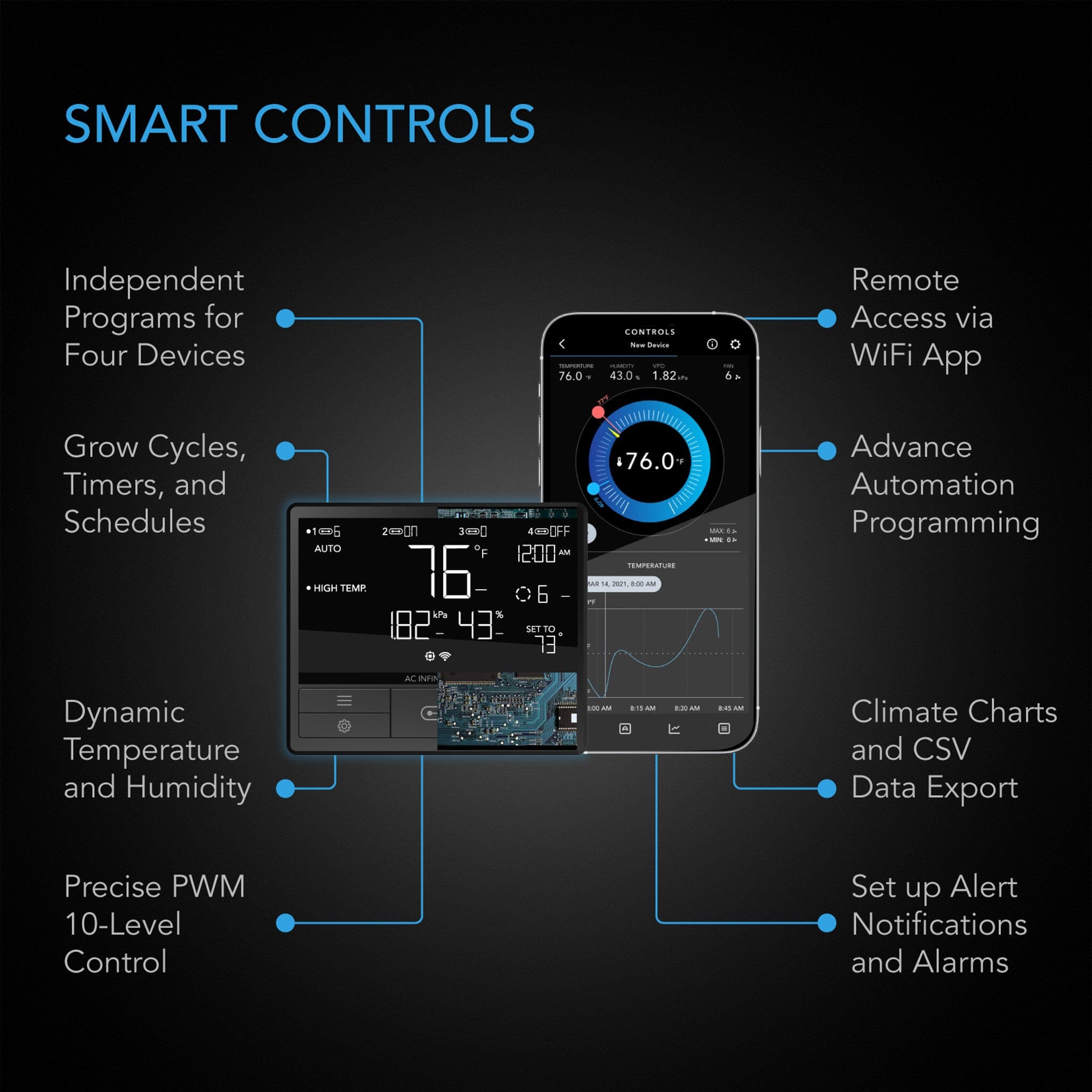
The Controller 69 Pro does more than switch the fan on and off. Set temperature, humidity and VPD triggers and the fan responds proportionally — speed rises as conditions drift and eases back as they recover, instead of slamming between off and full. Set a minimum speed and it never fully stops, so you keep constant air exchange through a carbon filter rather than letting odour build between cycles. Timer, cycle and schedule modes cover lights-on/lights-off routines, intermittent subfloor extraction, or a bathroom run-on after a shower.
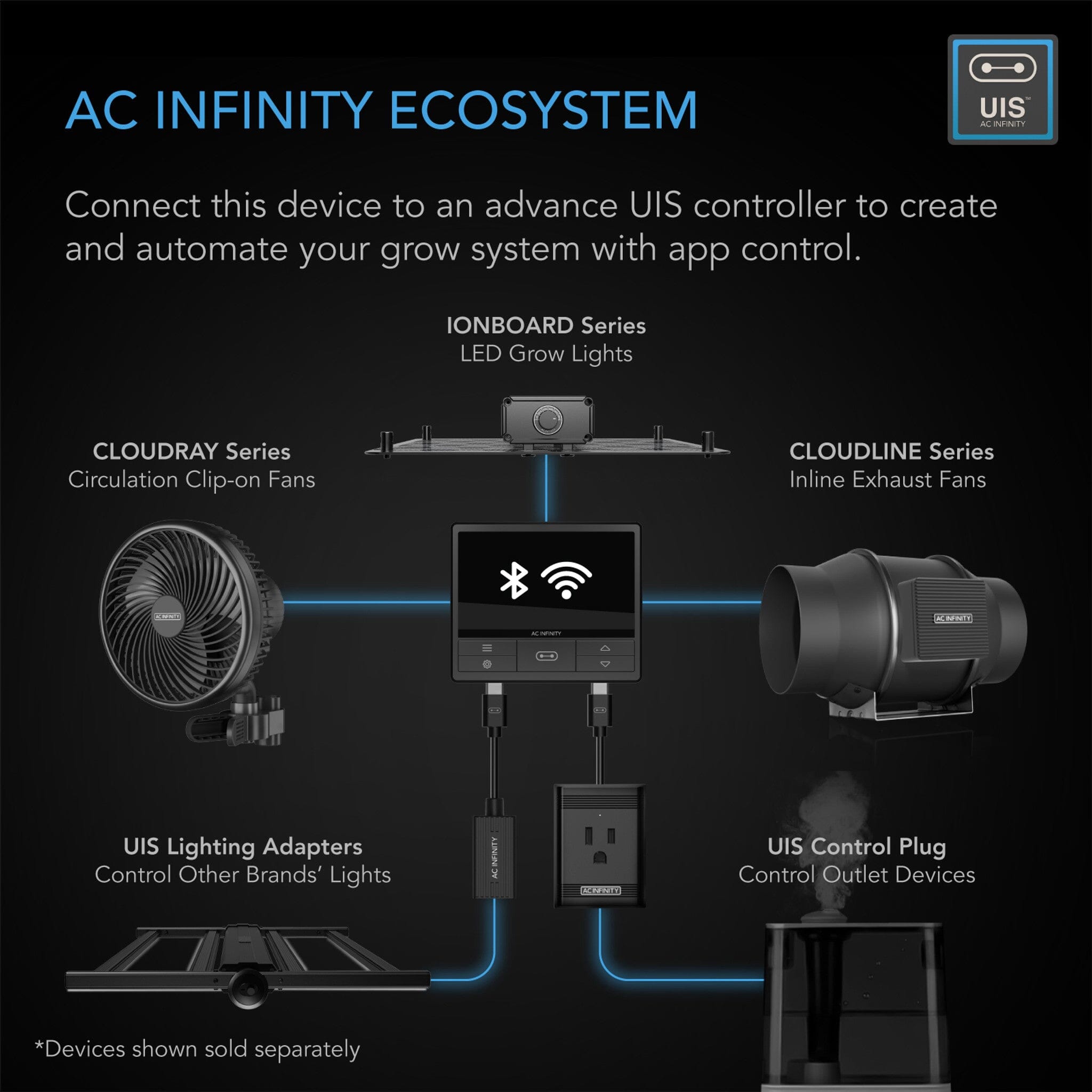
Connect over WiFi to the AC Infinity app for remote control, push notifications, historical climate charts and CSV export — useful if you want to actually see what your VPD did overnight rather than guess. The controller drives up to four UIS™ devices, so one unit can run this fan plus a Cloudray clip fan, a Cloudforge humidifier or an Ionframe light.
Quiet, energy-efficient performance
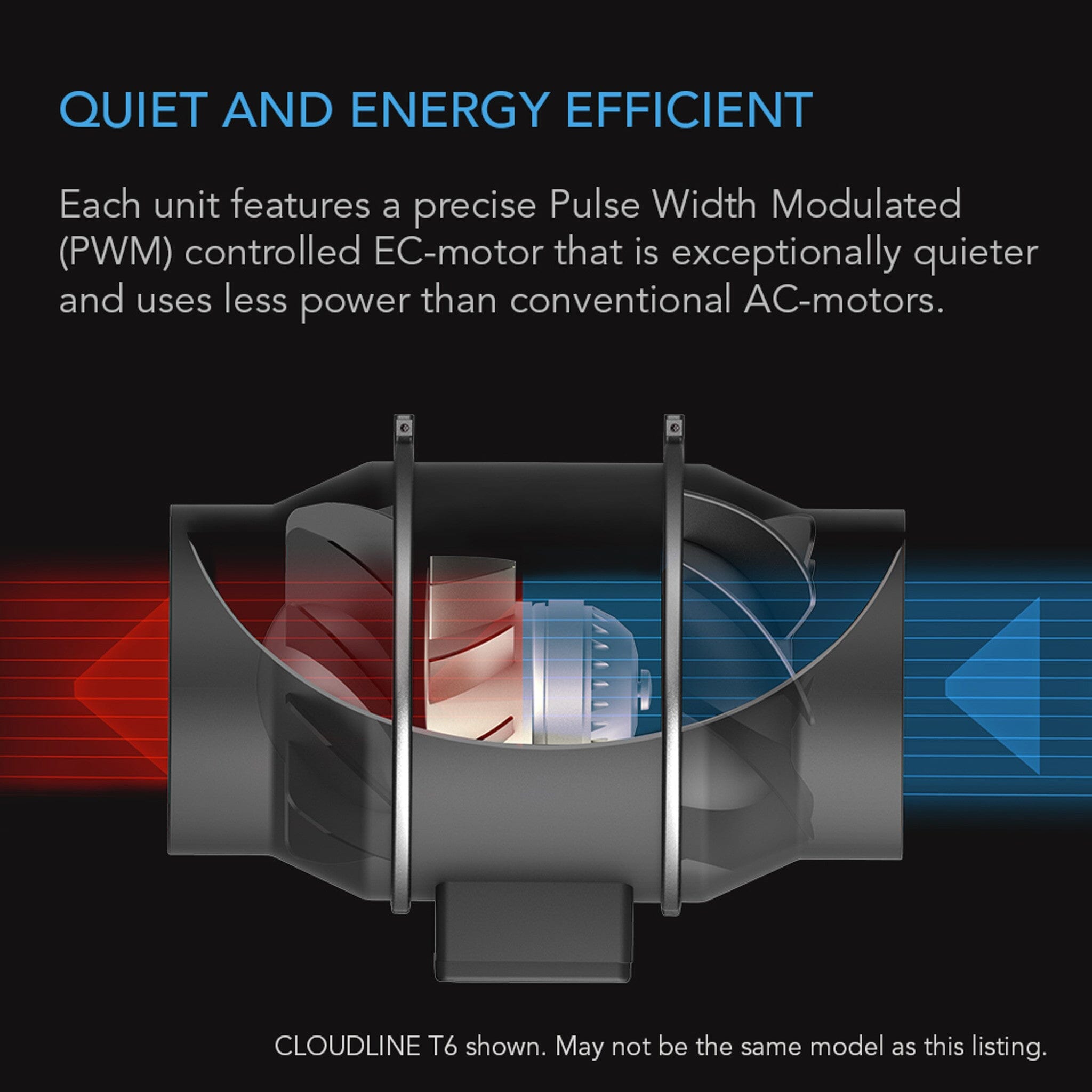
Most cheap duct fans use an AC motor — loud, one-note, and only crudely controllable. The T6 uses a PWM-controlled EC motor, which is why it can idle at genuinely low noise and why it draws so little power: 38 W average, 70 W maximum. That draw also falls away steeply as you dial the speed back, because fan power scales with roughly the cube of speed. An AC-motor fan pulls close to its full rated wattage the moment it's switched on, whatever speed you've set it to.
The mixed-flow design and 503 Pa static-pressure rating are what let it hold airflow once you add a carbon filter, a silencer and a few bends — the point where straight axial fans fall over. AC Infinity rate the dual ball bearings at 67,000 hours, the fan mounts horizontally or vertically, and the motor box detaches from the frame so you can pull it out and clean the impeller without dismantling your ducting.
What people use it for
Home ventilation
- Subfloor and underfloor moisture extraction
- Attics and roof spaces
- Garages, sheds and workshops
- Compliant ducted bathroom exhaust systems
- Room-to-room air transfer and AV equipment cooling
Hydroponic ventilation
- Grow tents up to 1.2 × 1.2 m (4×4)
- Indoor grow rooms
- Heat, humidity and odour extraction
- Fresh-air intake and circulation
- Automated VPD-based environment control
Full specifications
| Manufacturer | AC Infinity Inc. |
| Product / model | CLOUDLINE PRO T6 / AI-CLT6 |
| UPC | 854759004792 |
| Duct diameter | 150 mm (6″) |
| Fan dimensions | 200 × 320 × 212 mm |
| Mounting-hole spacing | 80 × 60 mm |
| Screw-hole diameter | 6 mm |
| Cord to controller | 3.05 m |
| Power cord | 2.44 m |
| Controller dimensions | 132 × 74 × 27 mm |
| Controller mounting spacing | 120 × 67 mm |
| Controller screw-hole diameter | 3 mm |
| Display size | 90 × 35 mm |
| Sensor-probe length | 3.66 m |
| Maximum airflow | 722 m³/h · 201 L/s (425 CFM) |
| Maximum noise | 30 dBA |
| Static pressure | 503 Pa |
| Voltage / frequency | 100–240 V AC / 50–60 Hz |
| Maximum / average power | 70 W / 38 W |
| Current | 0.94 A |
| Power connection | Australian three-pin plug |
| Operating range | 0–60°C / 35–85% RH |
| Ingress protection | IP44 |
| Mounting | Horizontal or vertical |
| Bearings | Dual ball |
| Rated bearing life | 67,000 hours (manufacturer rating) |
| In the box | Fan unit, Controller 69 Pro, corded thermal probe, two duct clamps, mounting hardware, manual |
| Certifications | SAA · CE · ETL · RoHS · IC |
| Product manual | CLOUDLINE S & T series manual (PDF) |
FAQ
What's the difference between the CLOUDLINE T6 and the S6?
The fan itself is identical — same motor, same impeller, same 425 CFM. The difference is control. The S6 comes with a simple 10-speed manual dial. The T6 comes with the Controller 69 Pro, which adds temperature, humidity and VPD triggers, dynamic speed, timers, schedules and WiFi app control. If you just want a fan you set once and forget, the S6 saves you money. If you want the fan to respond to conditions on its own, you want the T6.
What size grow tent will a T6 handle?
For growing, the T6 suits tents up to 1.2 × 1.2 m (4×4). That is a grow-tent rating, not a room limit: it allows for a carbon filter, the heat from the lights and roughly one full air change every minute, which is far more work than ventilating a room in a house. In a 4×4 with a carbon filter fitted, most growers sit around speed 5–6 and never need to go higher. If your tent is bigger than that, step up to a T8 rather than running a T6 flat out — a larger fan running slower is quieter, cooler and lasts longer than a smaller one at maximum. For a bathroom or other room in the home, see the questions below.
Is it actually quiet? Some reviews mention noise at high speeds.
Fair question, and worth answering straight. At the speeds most people run — up to about level 6 — it's quiet enough that you generally won't hear it outside the room. Above level 6 it does get audible, because it's moving more air than most competing 6″ fans do at the same setting. If you're regularly needing levels 8–10, that's the signal your space wants a larger fan, not that this one is underperforming. Adding a silencer and lined ducting makes a noticeable difference either way.
Can the Controller 69 Pro be powered on its own, separately from the fan?
No. The Controller 69 Pro draws its power through the fan, so it can't run as a standalone unit. This matters if you've since upgraded to a Controller AI+ and want to redeploy the 69 Pro elsewhere — the workaround most customers use is to plug a clip fan (a Cloudray, for example) into the spare 69 Pro. That gives the controller a power source and gets you a second independent climate zone plus a backup controller.
Will it still pull properly with a carbon filter and ducting attached?
Yes — that's what the mixed-flow design and 503 Pa static-pressure rating are for. Every filter, bend and metre of flexible duct costs you airflow, and a straight axial fan loses far more of its rated CFM under that load than a mixed-flow fan does. Keep duct runs as short and straight as you reasonably can and you'll retain most of the rated output.
Can I use it for subfloor, attic or bathroom ventilation rather than growing, and which size suits a bathroom?
Yes, and a good portion of the T6s we ship go to exactly those jobs. It's IP44-rated, mounts horizontally or vertically, and the climate triggers work just as well on subfloor moisture as on tent humidity. For bathroom exhaust, read the installation requirements above — it must be part of a properly designed ducted system.
Most people use the 150 mm for a bathroom, or the 100 mm for smaller rooms such as ensuites and toilets. The larger the fan, the quieter it is for the same airflow, because it can run slower. What suits your job also depends on the space in the ceiling, the duct route and how much noise you can live with, so if you are unsure, send us the details and we will help.
How does the airflow compare with a ceiling or bathroom exhaust fan?
Installers rate exhaust fans in m³/h or L/s. The T6 moves up to 722 m³/h (201 L/s) at full speed. For comparison, the National Construction Code minimum for a bathroom or toilet is 25 L/s (90 m³/h), and 40 L/s (144 m³/h) for a kitchen or laundry, discharged outdoors rather than into the roof space. Real airflow drops with every metre of duct, bend and grille, which is where the 503 Pa static pressure rating matters. Check the requirements for your job with your installer.
Can one controller run fans in two rooms?
The Controller 69 Pro runs up to four UIS fans, each on its own program, but it has one probe, so temperature and humidity are measured in one place only. A fan in a second room or the far end of a large space would react to readings from somewhere else. For two separate rooms, give each its own fan and controller. Within one room you do not need to switch it off: set a humidity or temperature trigger and the fan ramps up when the steam or heat builds and settles back down after. It also resumes its last setting after a power cut.
Is this a genuine AC Infinity unit with Australian warranty?
Yes. Quick Bloom Lights is the official Australian importer and distributor for AC Infinity. Every unit ships with an Australian three-pin plug, SAA certification, and a two-year warranty handled here in Sydney — no shipping units overseas and no dealing with an offshore seller if something goes wrong.