

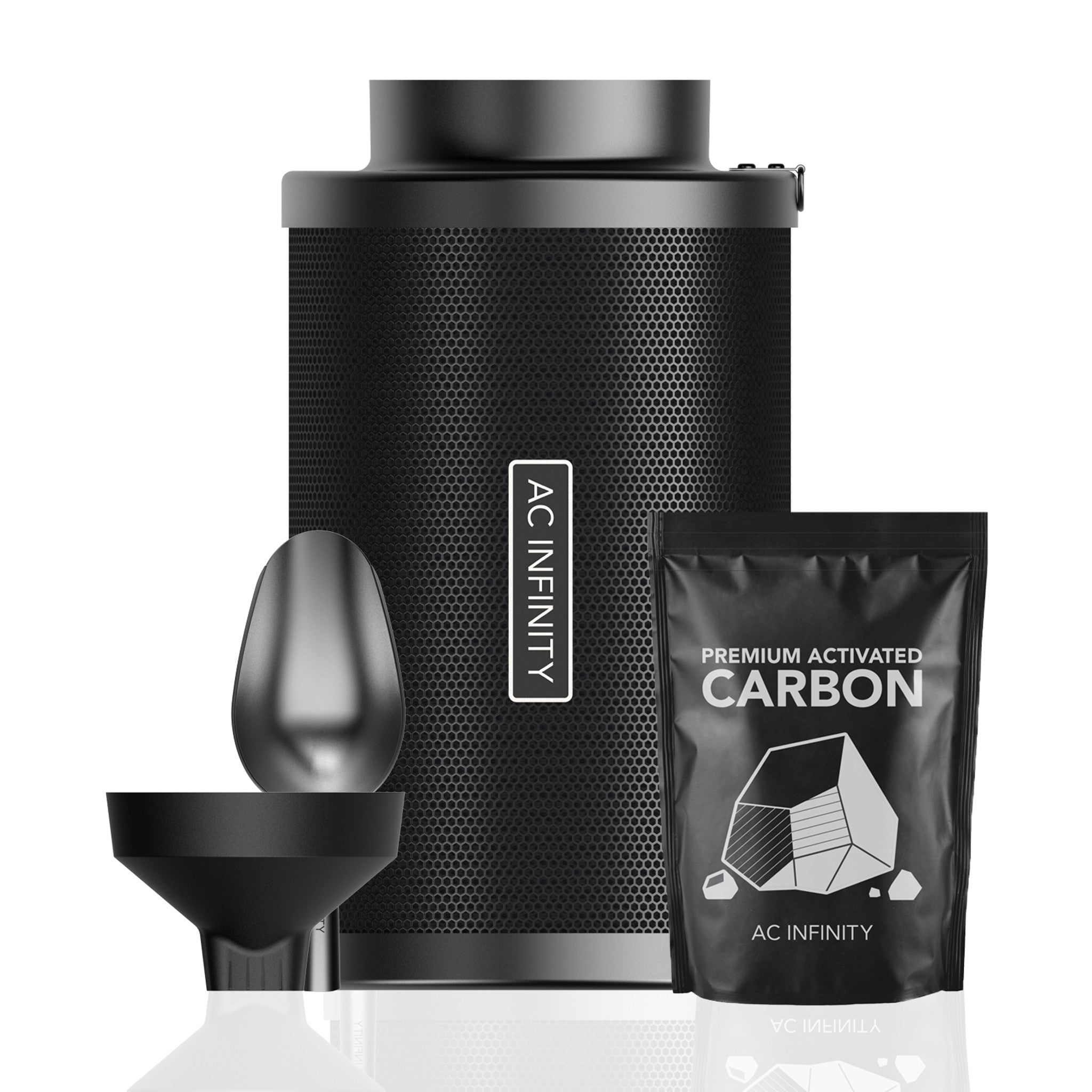
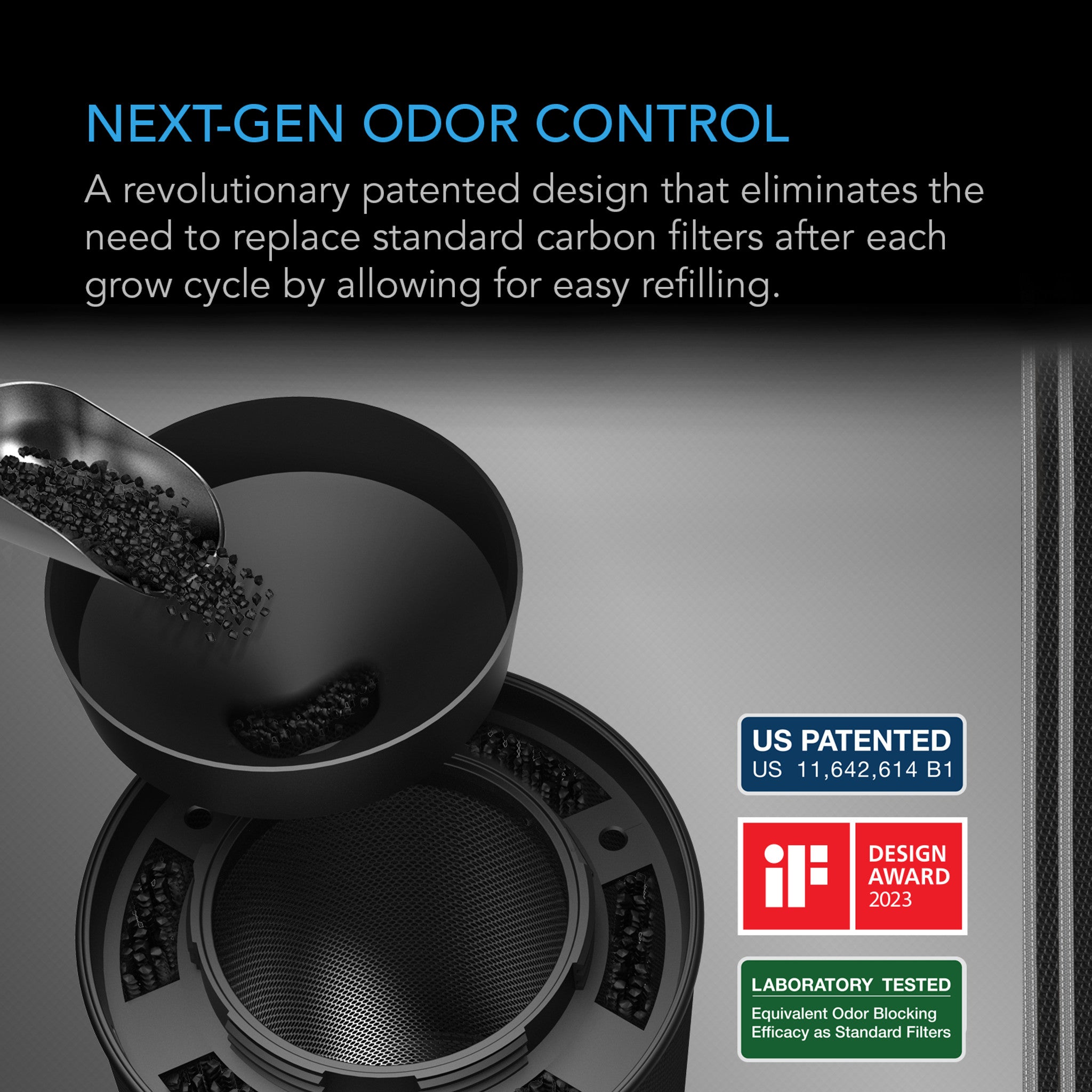
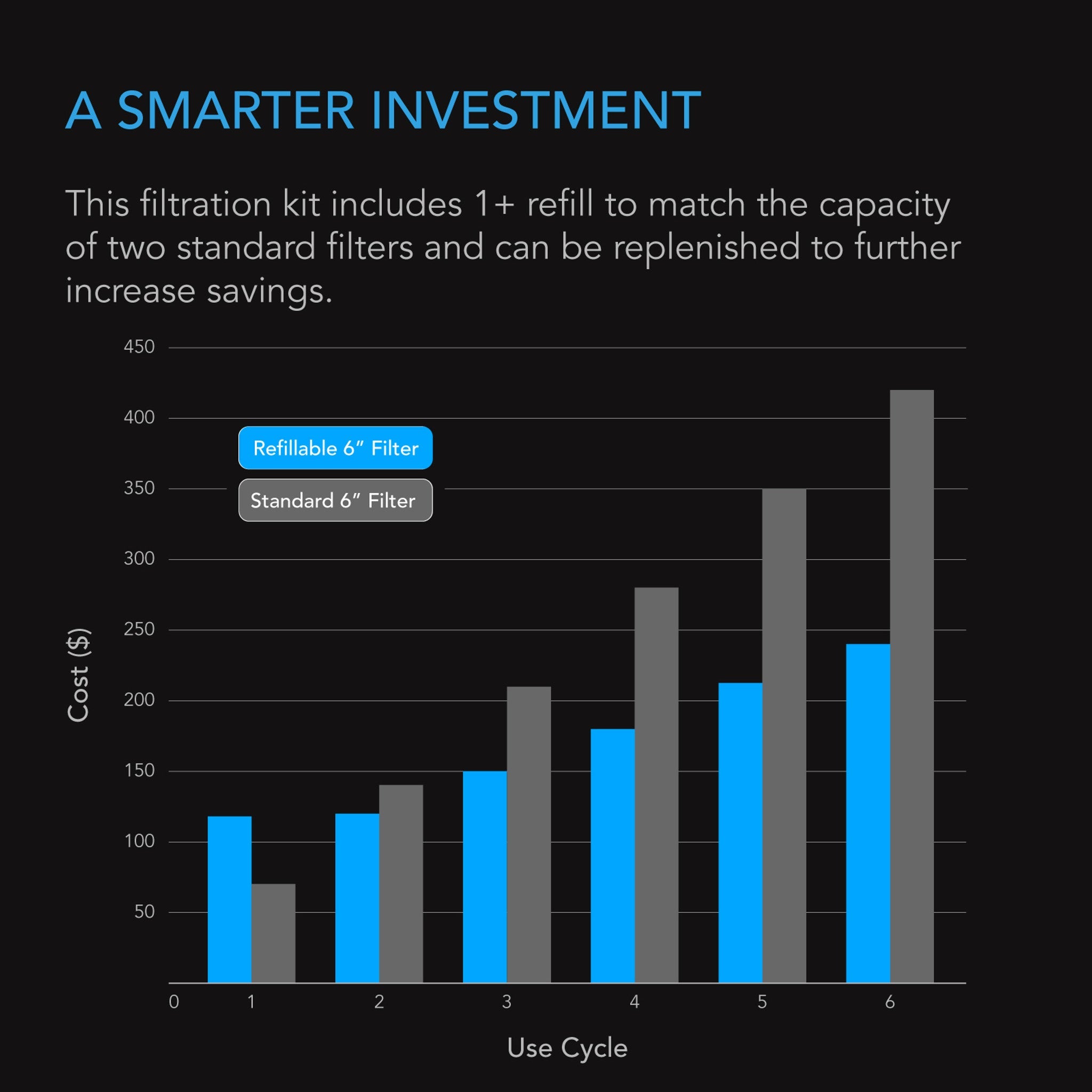
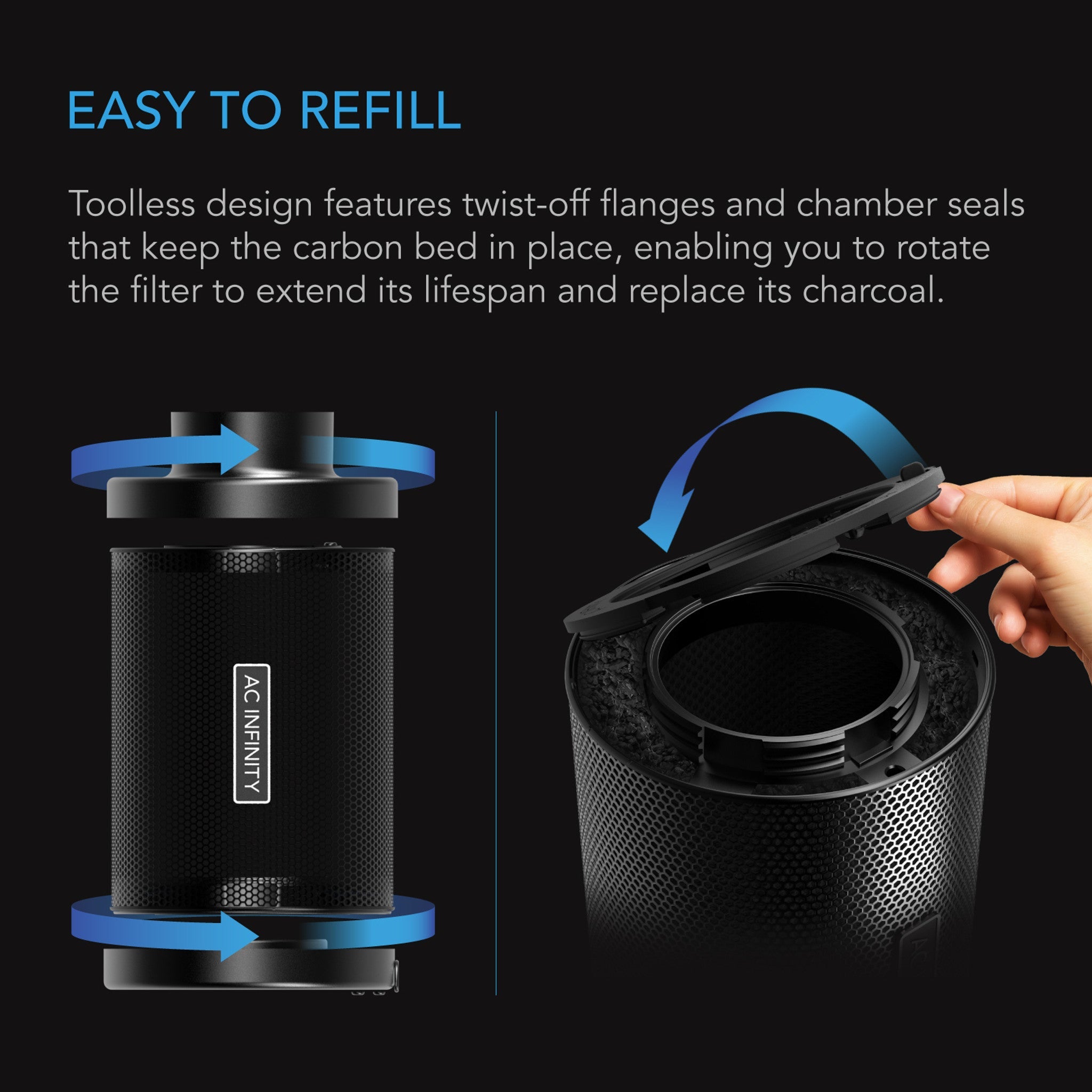


The AC Infinity Refillable Carbon Filter Kit 150 mm (6″) is a carbon filter you refill instead of replace. It uses the same Australian Virgin RC412 charcoal rated at 1200+ IAV in a 38 mm bed. IAV is the iodine adsorption value — how much odour the carbon can actually hold — and it is the number cheap filters quietly leave out, usually because they pair low-IAV carbon with a thin bed. The difference is the patented twist-off flange design: when the carbon is finally spent you tip it out and repack the housing with fresh charcoal, keeping the mesh, flanges and pre-filter. The kit ships with a spare refill included, so it arrives with roughly twice the filtration life of a standard filter. Quick Bloom Lights is the official Australian importer: stocked in Sydney, shipped domestically.
How refilling actually works
The flanges twist off by hand — no tools. Tip the spent carbon out, refill using the included funnel and scoop, and reassemble. The chamber is deliberately oversized so it reaches factory carbon compression on its own: you do not need to pack or tamp the charcoal down, and AC Infinity lab-test the refilled filter as blocking odour to the same standard as a sealed factory filter.
Refills come as bulk activated carbon in 3.6, 7.3 and 14.5 kg bags (8, 16 and 32 lb). A 150 mm filter refills 1+ time from an 8 lb bag, 2+ from 16 lb, 4+ from 32 lb.
It still reverses
Everything the standard filter does, this does too. Air loads the intake end of a carbon bed hardest, so when odour starts getting through you can reverse the flanges and run the unused end first — then refill when that end is spent as well. Between reversing and refilling, the housing itself can stay in service for years.
Which one should you buy?
If you are choosing between this and the standard Duct Carbon Filter in the same size, the honest answer is that the refillable kit is the better long-term buy for most people: same carbon, same bed depth, same airflow rating, and the only thing you buy again is charcoal rather than a whole new filter. The standard filter is the simpler unit and cheaper up front, and it is the only option at 250 and 300 mm.
Full specifications
| Manufacturer | AC Infinity Inc. |
| Product / model | Refillable Carbon Filter 6″ / AC-RCF6 |
| UPC | 819137024175 |
| Duct opening | 150 mm (6″) |
| Total dimensions | 405 × 227 mm |
| Flange length | 40 mm |
| Carbon type | Australian Virgin RC412 |
| Carbon grade | 1200+ IAV |
| Carbon bed depth | 38 mm |
| Maximum airflow | 410 CFM |
| Flange material | Aluminium |
| Flange design | Reversible, twist-off for refilling |
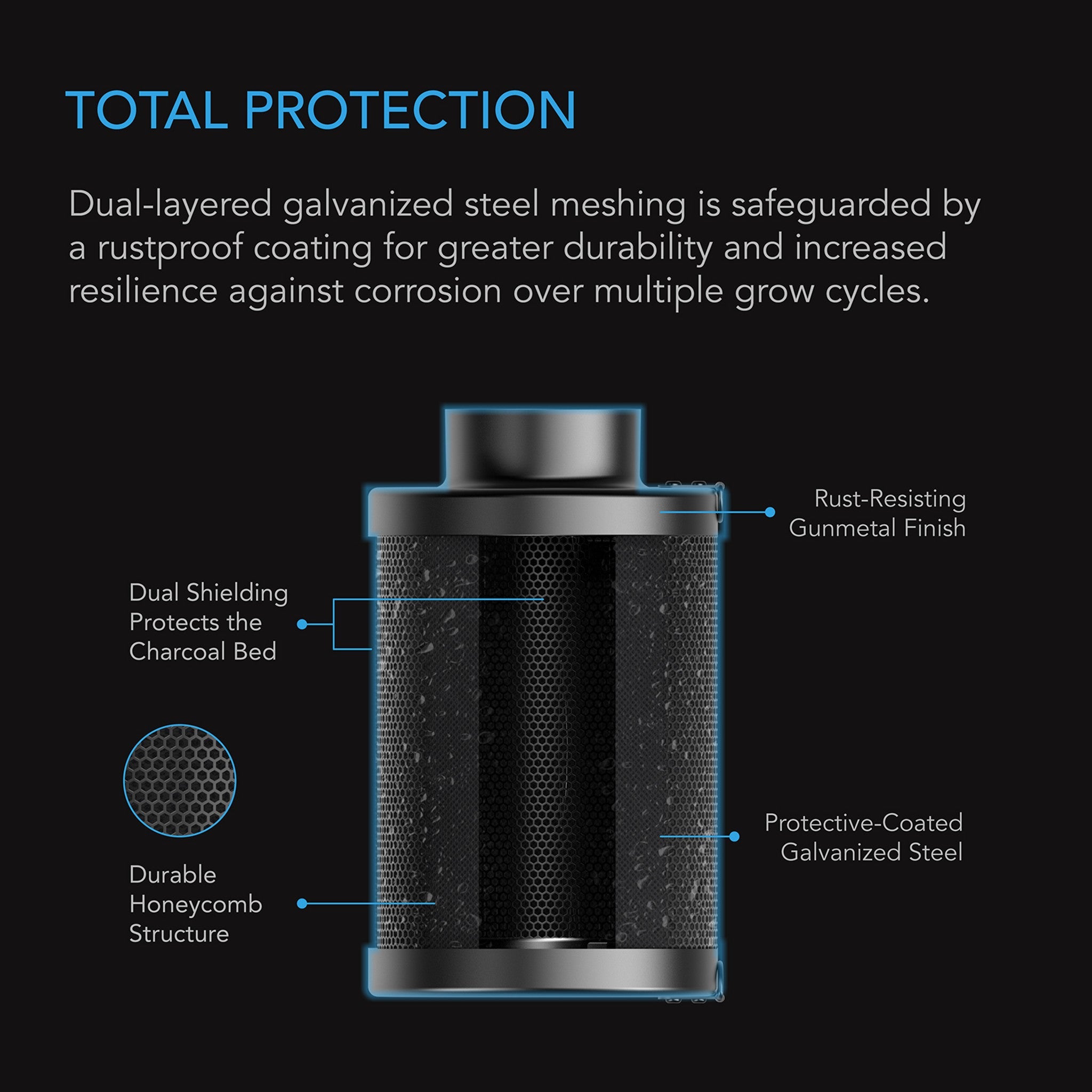
| Mesh | Dual-layer rust-resistant galvanised steel, gunmetal finish |
| In the box | Filter, one spare carbon refill, funnel and scoop, pre-filter cloth, hanging straps |
| Product manual | Download PDF |
FAQ
How is this different from the standard Duct Carbon Filter?
Same carbon, same 38 mm bed, same airflow rating, and both reverse. The refillable kit adds the one thing the standard filter cannot do: it opens so you can tip out spent charcoal and repack it. It also ships with a spare refill, so it starts with about twice the filtration life in the box.
Do I need to compress the carbon when I refill it?
No, and that is the point of the oversized chamber — it achieves factory compression without you tamping anything. Pour it in with the funnel, reassemble, done.
When do I refill rather than reverse?
Reverse first. When odour starts escaping, flip the filter and run the unused end. When smell returns after that, the bed is genuinely spent and it is time to repack.
How long does it last?
Around 12 months is the usual working figure, and in favourable conditions growers report 18 months or more. Treat that as a guide rather than a guarantee: filter life depends far more on your environment than on the calendar. What shortens it is running the fan hard around the clock, a heavy odour load, dusty air, and above all high humidity — carbon adsorbs water vapour as readily as it adsorbs odour, so a persistently humid room ages a filter long before its carbon is chemically spent.
Should it be running during veg?
Usually not, and this is the advice that costs us filter sales. Veg combines the highest humidity with the least odour, so the carbon spends weeks adsorbing water vapour instead of smell, its pores clog with moisture, and you burn through filter life scrubbing air that had little in it to scrub. Run the fan and ducting as normal for airflow, and fit the filter when you actually need it — when odour appears, or at the flip into flower once humidity comes down. A filter introduced then goes into service with its full capacity intact.
Should it go on the intake or the exhaust side?
Exhaust, for odour control — the fan pulls air through the filter and out, scrubbing everything leaving the room. Filters can be run on the intake side to clean incoming air, but that is about dust and pollen, not smell.
What is the pre-filter cloth for, and how often should I wash it?
The pre-filter is the cloth sleeve that pulls over the outside of the filter. Air is drawn in through the outside of the filter, so the sleeve catches dust, debris and plant matter before it can reach and clog the carbon. It is one of the simplest ways to get more life out of the filter. Wash it every 1–4 weeks, or sooner if it looks dirty — dusty spaces need it more often. Let it dry completely before it goes back on, because a damp sleeve feeds moisture straight into the carbon. Keep the pre-filter clean and dry and the filter works better and lasts longer. Never wash the filter itself.
What does 1200+ IAV mean?
IAV is the iodine adsorption value, a measure of how much odour a given weight of carbon can hold. Higher means more capacity and a longer service life. Cheap filters often use low-IAV carbon, a thin bed, or both, which is why they seem fine for a month and then stop working.
Is this genuine AC Infinity stock with Australian warranty?
Yes. Quick Bloom Lights is the official Australian importer and distributor for AC Infinity. Stock is held in Sydney, orders ship domestically, and warranty is handled here rather than through an overseas seller.