

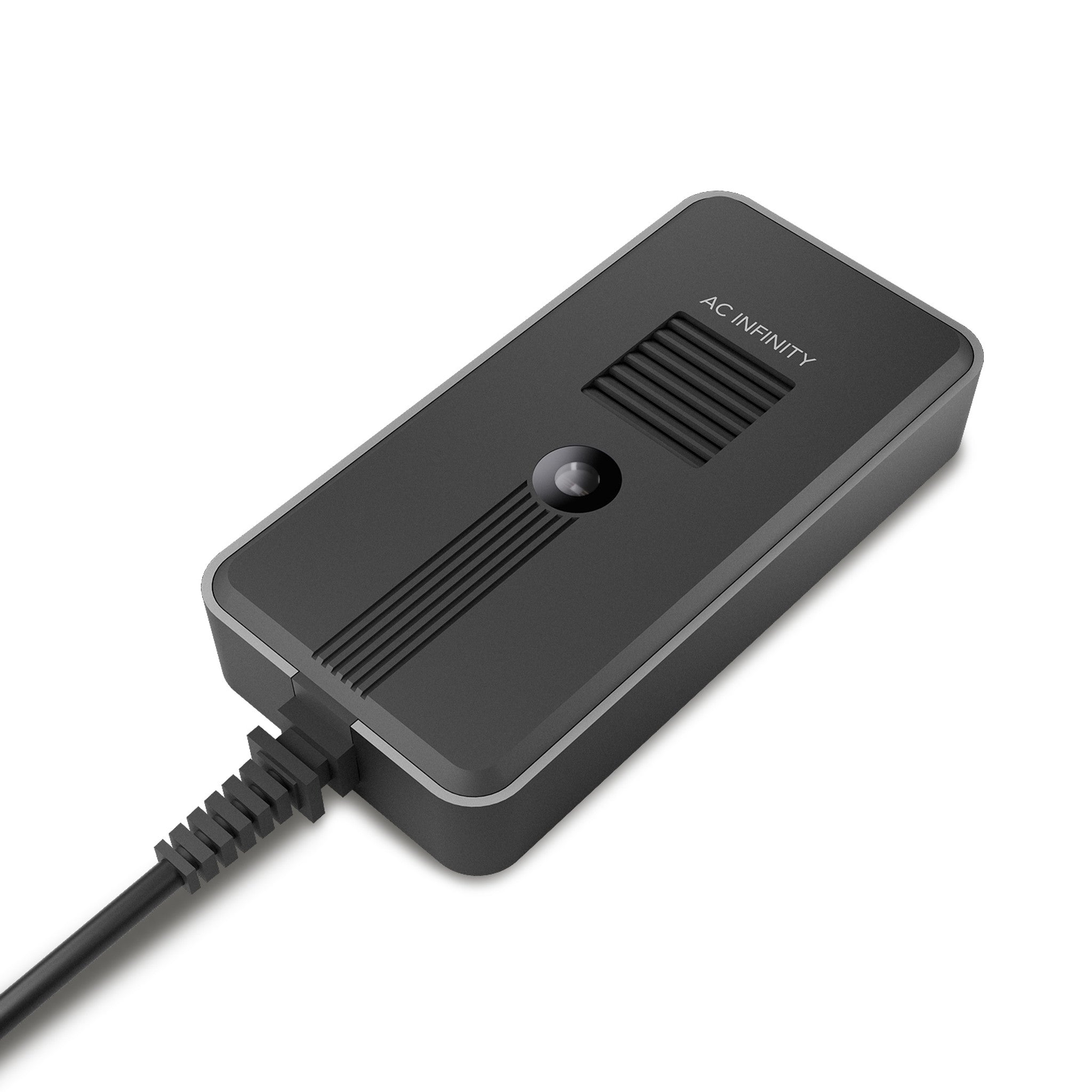
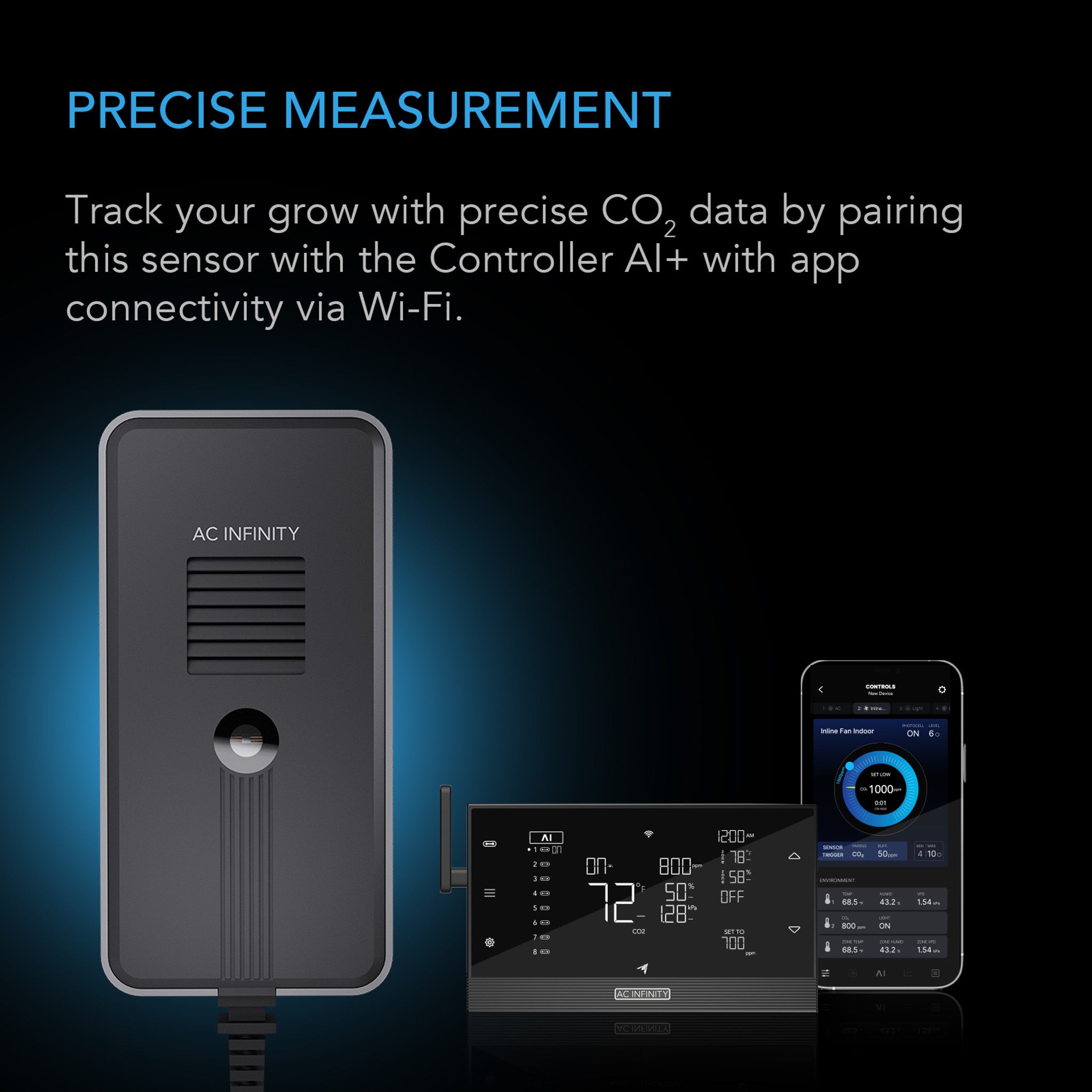
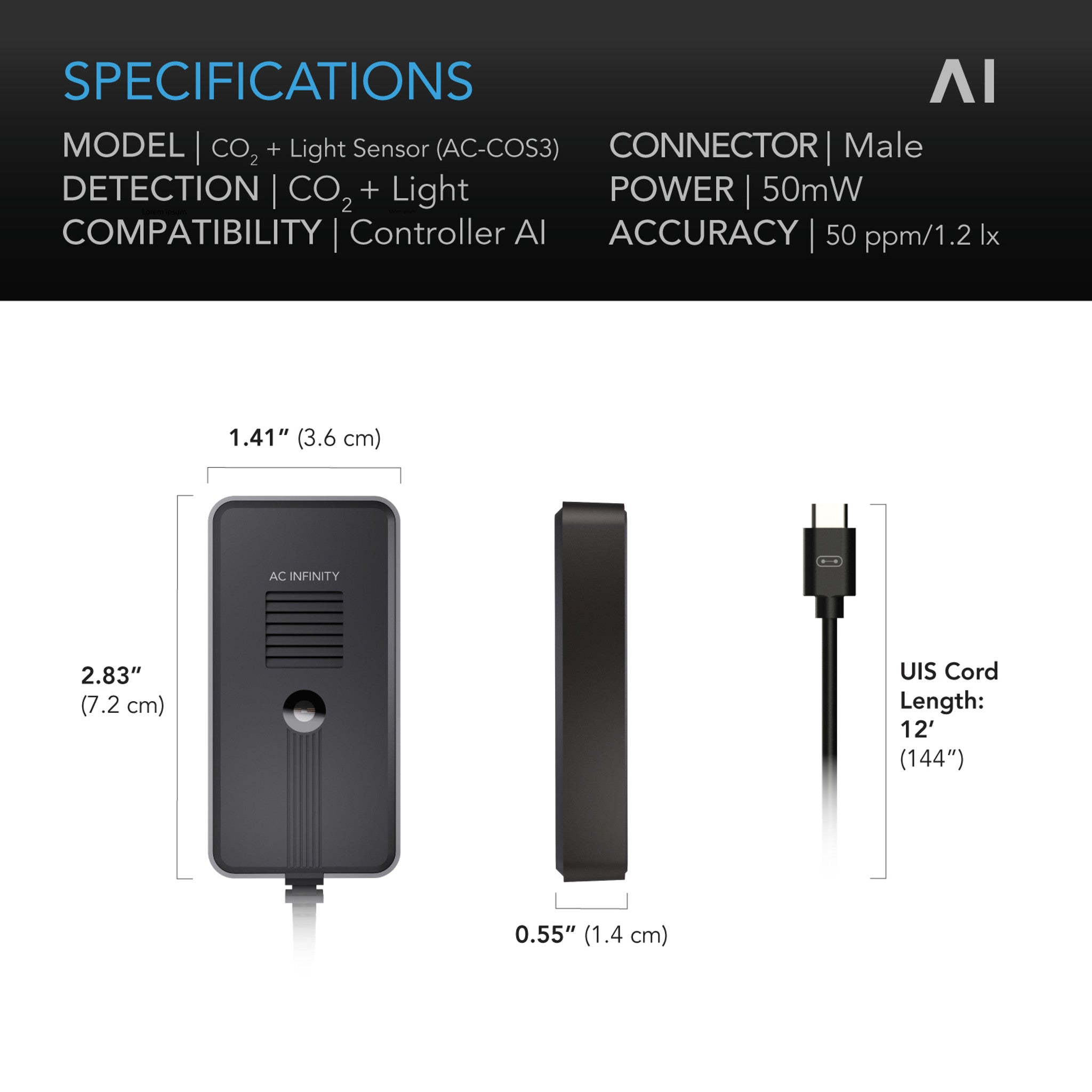

The AC Infinity CO₂ + Light Sensor is a plug-in sensor for the Controller AI+ that reads carbon dioxide in parts per million and ambient light in lux. It is the piece that turns a climate controller into a CO₂ controller: the readings drive your fresh air exchange, your day and night scheduling, and — with a control plug and a solenoid — the CO₂ supply itself.
Build a WiFi CO₂ controller for a fraction of the price
This is the setup we run ourselves, and most people have never been told it is possible. Take a Controller AI+, put this sensor in a sensor port, plug a UIS Control Plug into a device port, and run a CO₂ regulator and solenoid from the control plug. The controller now holds a ppm target by switching the solenoid, with the whole thing visible and adjustable from the app on your phone.
A dedicated CO₂ controller does that one job and costs considerably more. This does it inside the system already running your fans, lights, humidifier and heater — which is the part that matters, because the controller knows to stop the extraction fan venting the CO₂ you just released. Both the control plug and the regulator we stock are fitted with Australian plugs, so no adapters are involved.
Fresh air exchange that costs you less gas
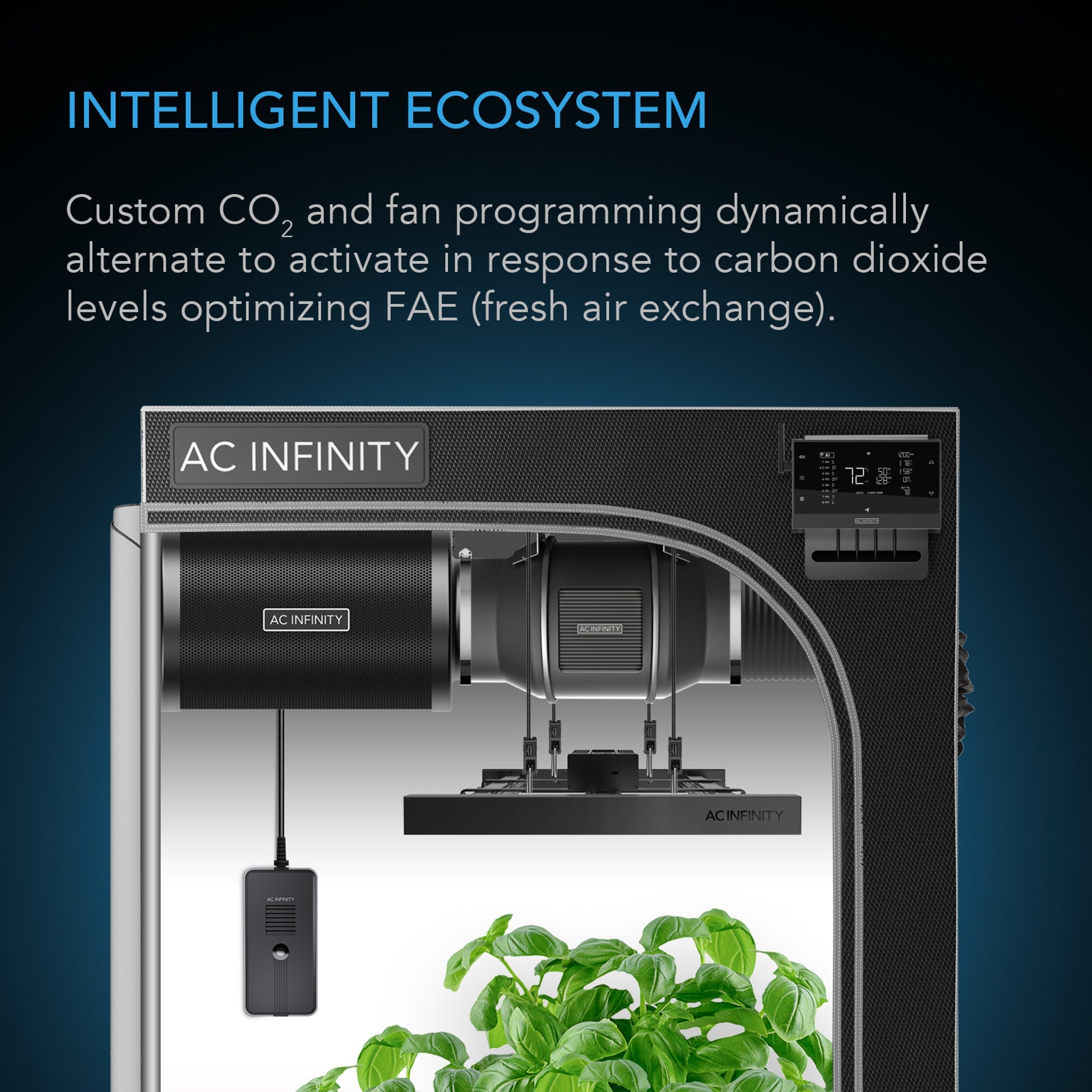
Without a CO₂ reading, extraction runs on temperature and humidity alone and happily dumps enriched air out the duct. With this sensor the controller can coordinate the two: run the fan when ppm says the air genuinely needs replacing, hold off when it does not, and set a minimum intake speed so exchange never stops entirely. That is the practical efficiency gain — less gas out the duct, steadier ppm at the canopy.
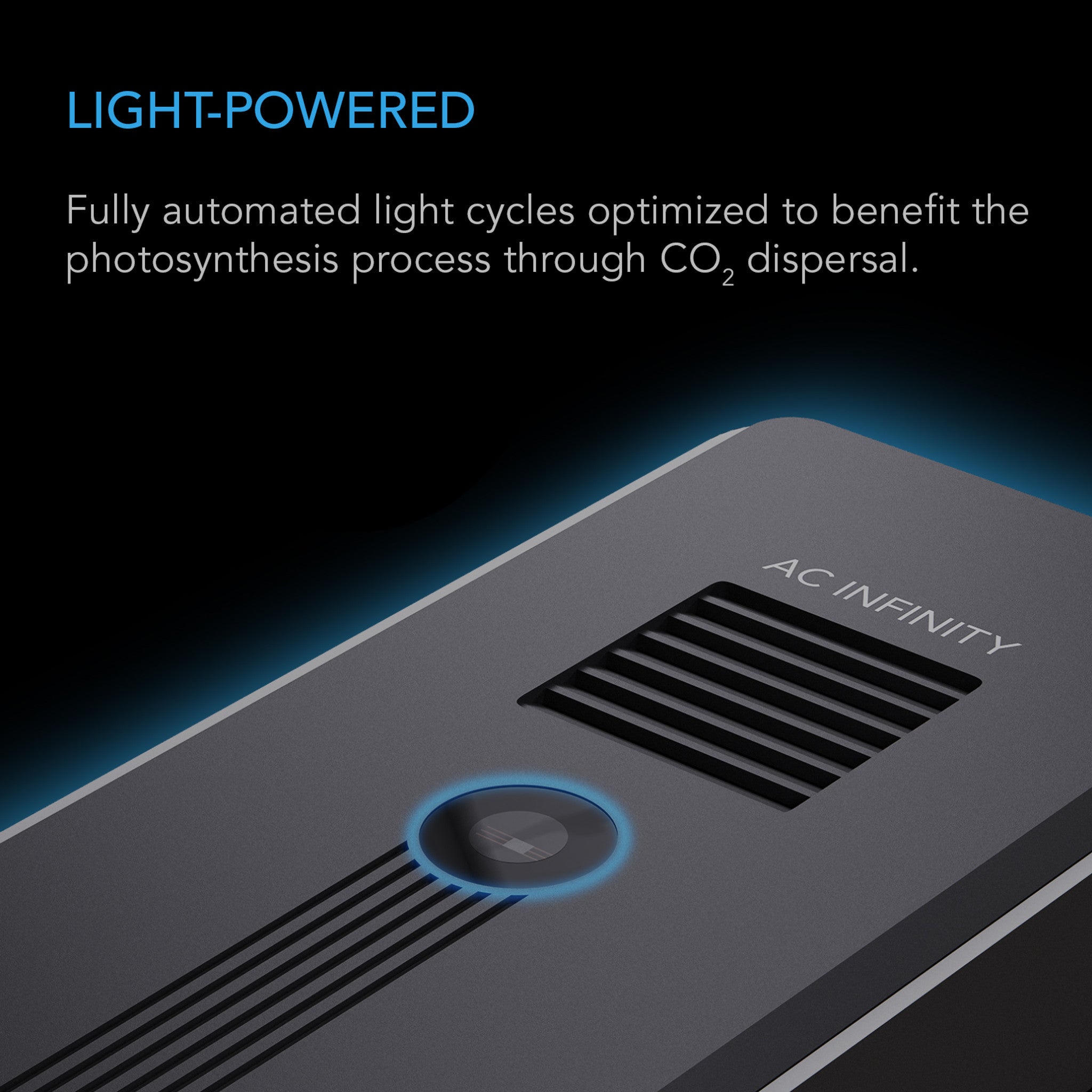
The light sensor handles the other half. Plants only use CO₂ while the lights are on, so the sensor lets the controller schedule enrichment to the actual light cycle rather than a clock you have to keep in sync. Day and night programs, precision cycling and full ppm logging all sit in the AC Infinity app alongside your climate charts.
Specifications
| Product identification | |
| Manufacturer | AC Infinity Inc. |
| Product name | CO₂ + Light Sensor for Controller AI+ |
| Model | AC-COS3 |
| UPC | 819137024779 |
| Dimensions | |
| Sensor dimensions | 3.6 × 7.2 × 1.4 cm (1.41 × 2.83 × 0.55 in) |
| Cord length | 3.66 m (12 ft) |
| Performance and technical | |
| Detection range | CO₂: 0–40,000 ppm · Light: 1–65,535 lx |
| Accuracy | CO₂: 50 ppm ± 5% · Light: 1.2 lx |
| Response time | CO₂: 60 s · Light: 120 ms |
| Compatibility | Controller AI+ (AI sensor port) |
| Operating temperature | 0–50 °C (32–122 °F) |
| Operating humidity | 35–60% RH |
FAQ
What else do I need to actually control CO₂, not just measure it?
Three things beyond this sensor: a Controller AI+, a UIS Control Plug, and a regulator with a solenoid valve on a CO₂ bottle. The sensor reads ppm, the controller decides, the control plug switches the solenoid's power, the solenoid opens and closes. Call or email us if you want the parts list checked against your room before you order.
Will it work with a Controller 69 Pro or Pro+?
No. The AI sensor range plugs into the sensor ports on the Controller AI+, which the 69 line does not have. If you are on a 69 and want CO₂ control, the AI+ is the upgrade path.
Can I use this and a soil or hydro sensor at the same time?
Yes — the controller has two sensor ports, so this plus one other. It is three sensors in total once you count the one built into the controller. More than that is not possible today; there is no sensor splitter yet, and the UIS 4-port hub only expands device ports.
Does the light sensor measure PAR or DLI?
No. It reads illuminance in lux, from 1 to 65,535 lx. That is plenty for the controller to know your lights are on and schedule around them, but it is not a quantum sensor and will not give you PPFD or a daily light integral.
Where should I mount it?
At canopy height, out of the direct path of the intake and away from the CO₂ outlet itself — both will give you a reading of the air passing the sensor rather than the air the plants are in. The 3.66 m cord gives you room to put the sensor where the plants are and the controller where you can reach it.
Is CO₂ worth it for my space?
It pays off when the rest of the room is already dialled in — light intensity at the top of what your plants can use, temperature and VPD steady, nutrition not a limiting factor. Enrichment lifts the ceiling once nothing else is holding you back; it will not rescue a space that is short on light. If you are not sure which you are, run a fortnight of readings first and look at the charts.