

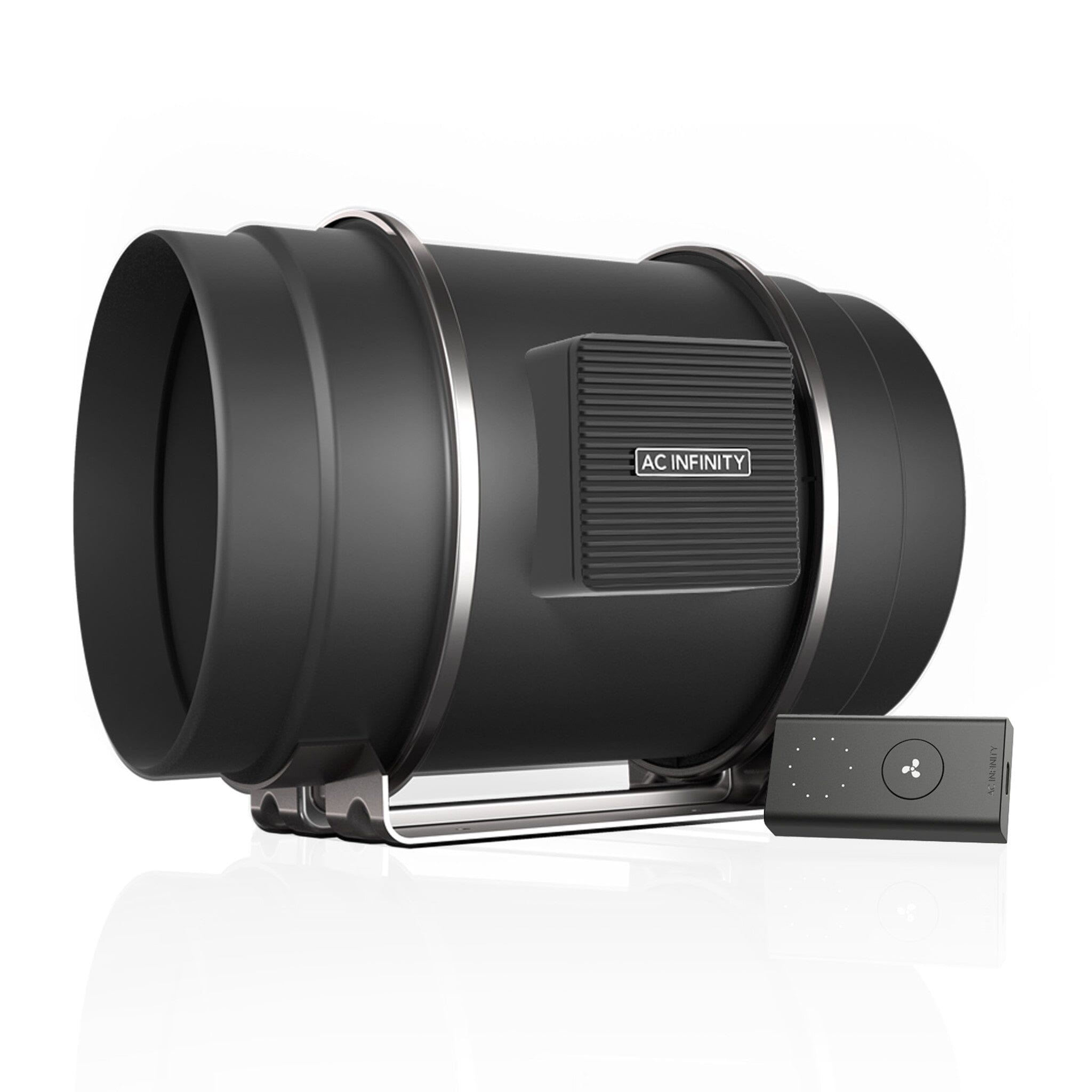
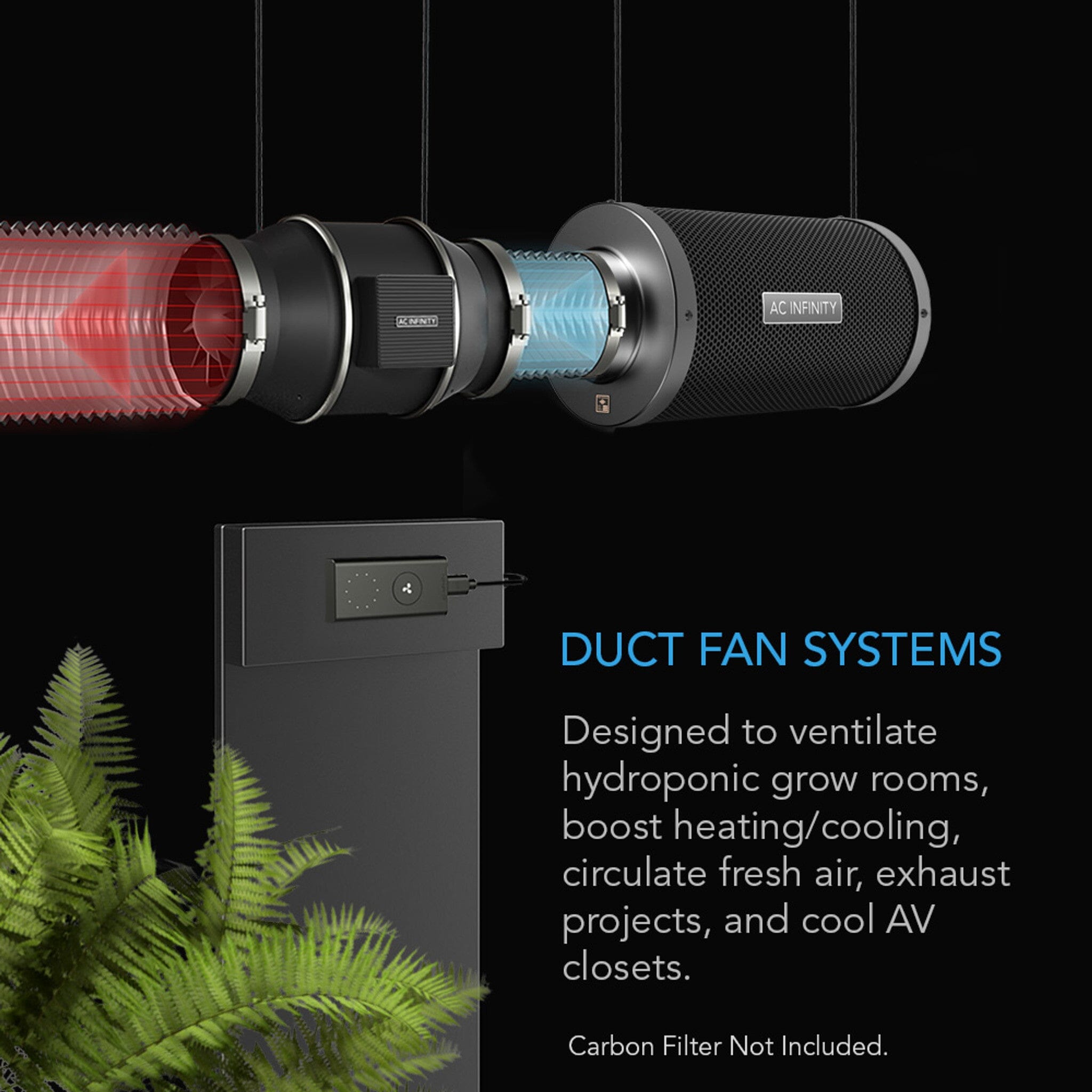


The AC Infinity CLOUDLINE PRO S8 is a 200 mm (8″) inline duct fan for spaces that need serious air moved quietly — 1,456 m³/h · 404 L/s (857 CFM) from a mixed-flow impeller and a PWM-controlled EC motor, paired with a corded 10-speed dial rather than a smart controller. At 38 dBA it is genuinely quiet for its size, and 746 Pa of static pressure is what lets it hold that airflow once a carbon filter and a few metres of ducting are in the way. If you want a big fan you set once and leave alone, this is the one.
Set-and-forget speed control
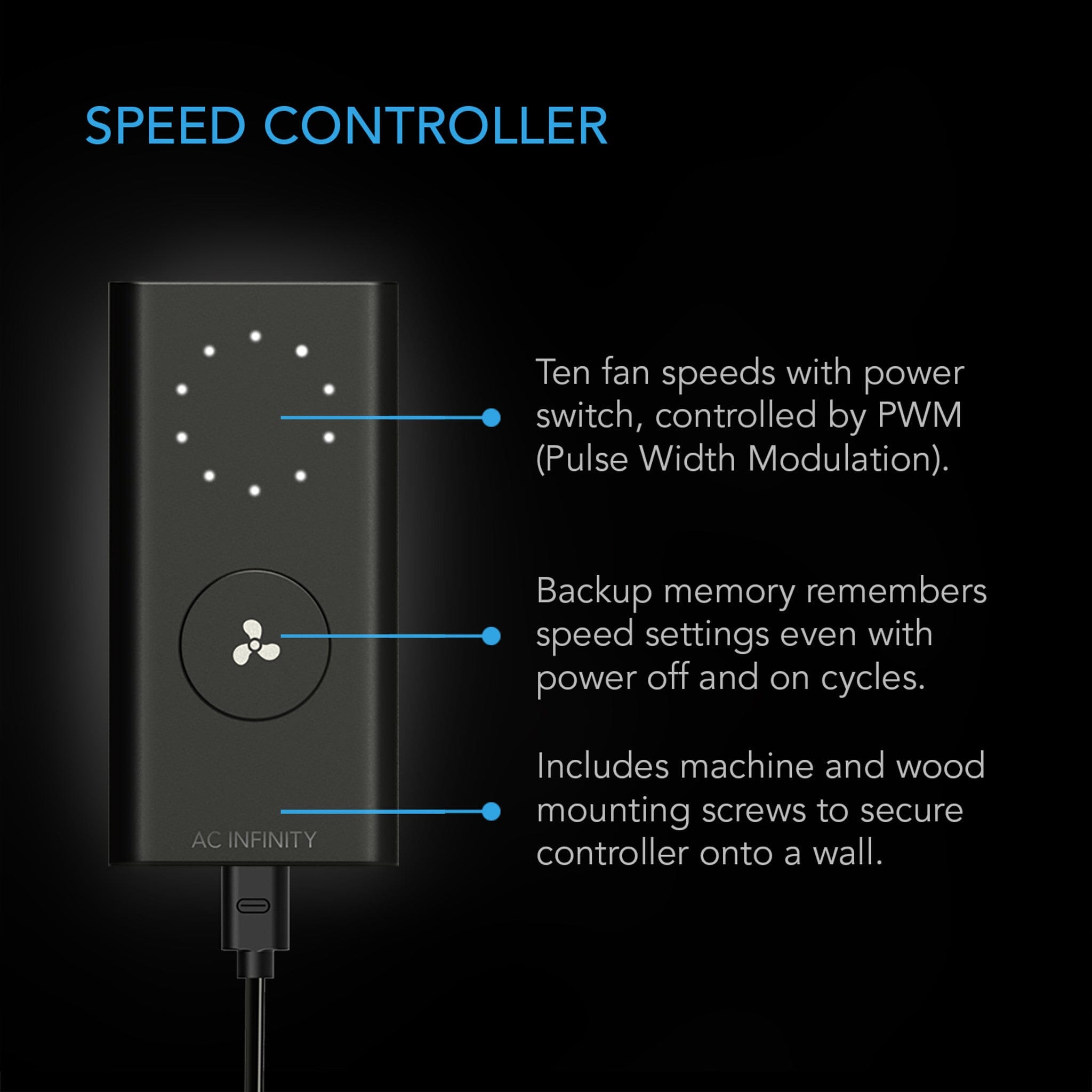
The included controller is a corded dial with ten speed levels and backup memory — cut the power and it returns to the setting you left it on. No menus, no app, no probe to position. For a room where conditions barely change, that is usually all the control the job needs, and it is the reason the S8 costs less than the T8.
The controller sits on a 3.05 m lead so it can live outside the space the fan is in. Speed changes are handled by the EC motor through PWM rather than by choking voltage, so the low settings stay smooth and quiet instead of humming.
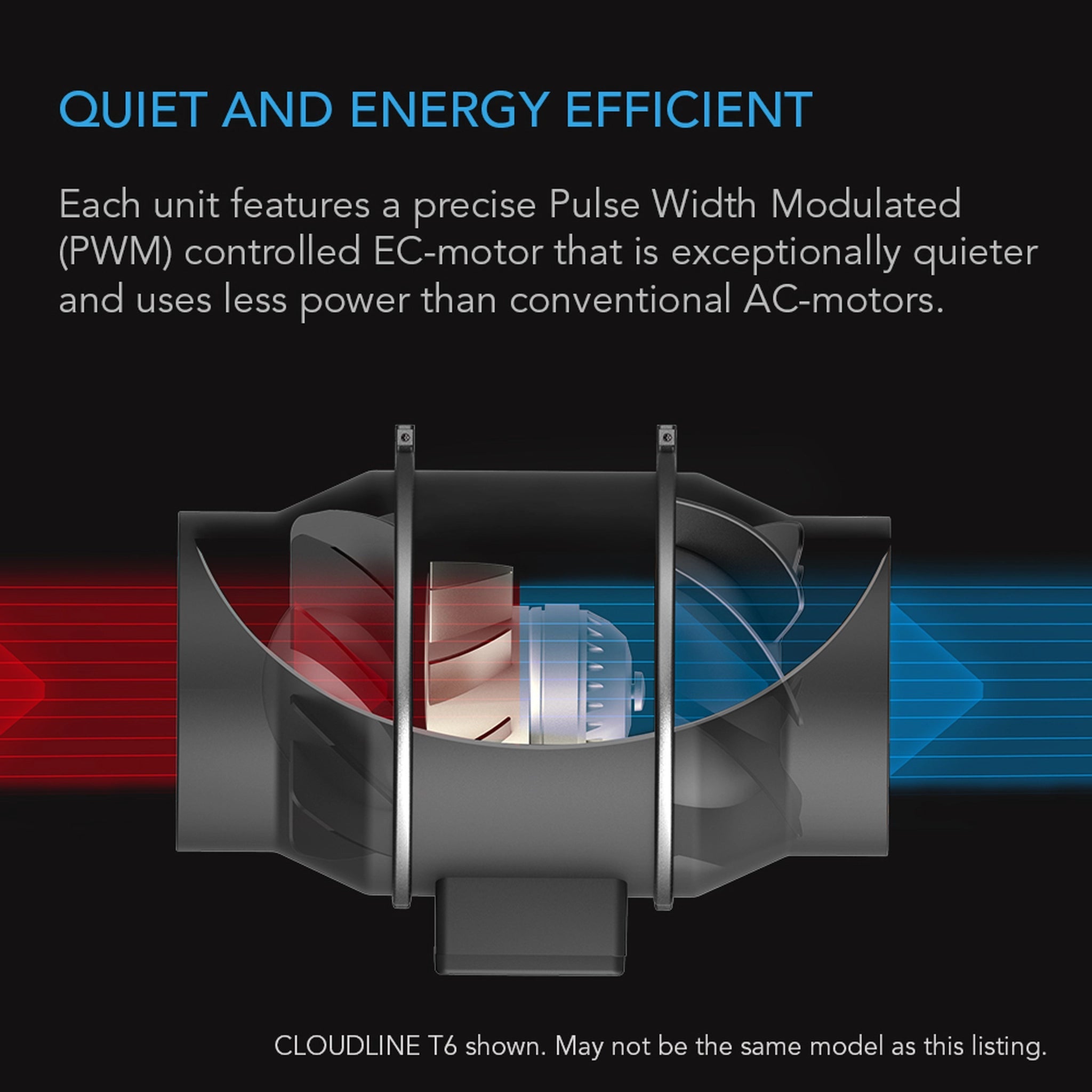
Quiet, energy-efficient performance
Most cheap duct fans use an AC motor — loud, one-note, and only crudely controllable. The S8 uses a PWM-controlled EC motor, which is why it can idle at genuinely low noise and why it draws so little for its size: 78 W average, 180 W maximum. That draw falls away steeply as you dial the speed back, because fan power scales with roughly the cube of speed. An AC-motor fan pulls close to its full rated wattage the moment it is switched on, whatever speed you have set.
The mixed-flow design and 746 Pa static-pressure rating are what hold airflow up once you add a filter, a bend or two and some flexible duct. Worth knowing where that sits in the range: 746 Pa is strong, but it is not the highest CLOUDLINE figure — the T10 and T12 are higher. AC Infinity rate the dual ball bearings at 67,000 hours, the fan mounts horizontally or vertically, and the motor box detaches from the frame so you can pull it out and clean the impeller without dismantling your ducting.
What people use it for
Home and commercial ventilation
- Large subfloor and underfloor extraction
- Roof space, attic and warehouse ventilation
- Workshops, garages and machine rooms
- Long duct runs where airflow has to survive the distance
Hydroponic ventilation
- Grow tents around 1.5 × 1.5 m (5×5) and larger rooms
- Filtered extraction through a 200 mm carbon filter
- Multi-tent and multi-bench setups
- Heat and humidity extraction at volume
Full specifications
| Manufacturer | AC Infinity Inc. |
| Product / model | CLOUDLINE PRO S8 / AI-CLS8 |
| UPC | 819137020849 |
| Duct diameter | 200 mm (8″) |
| Fan dimensions | 217 × 302 × 233 mm |
| Mounting-hole spacing | 100 × 94 mm |
| Cord to controller | 3.05 m |
| Power cord | 2.44 m |
| Controller | Corded 10-speed dial with backup memory |
| Maximum airflow | 1,456 m³/h · 404 L/s (857 CFM) |
| Maximum noise | 38 dBA |
| Static pressure | 746 Pa |
| Voltage / frequency | 100–240 V AC / 50–60 Hz |
| Maximum / average power | 180 W / 78 W |
| Current | 2.3 A |
| Power connection | Australian three-pin plug |
| Operating range | 0–60 °C / 35–85% RH |
| Ingress protection | IP44 |
| Mounting | Horizontal or vertical |
| Bearings | Dual ball |
| Rated bearing life | 67,000 hours (manufacturer rating) |
| In the box | Fan unit, corded 10-speed speed controller, two duct clamps, mounting hardware, manual |
| Certifications | SAA · CE · ETL · RoHS · IC |
| Product manual | CLOUDLINE S & T series manual (PDF) |
FAQ
What's the difference between the CLOUDLINE S8 and the T8?
The fan itself is identical — same motor, same impeller, same 857 CFM. The difference is control. The S8 comes with a corded 10-speed dial. The T8 comes with the Controller 69 Pro, which adds temperature, humidity and VPD triggers, dynamic speed, timers, schedules and WiFi app control. If you will set a speed once and leave it, the S8 saves you money. If you want the fan reacting to conditions on its own, you want the T8.
Is a 200 mm fan too much for my grow tent?
It can be, and oversizing has a real cost — in price, in the size of the filter and ducting you need, and in the physical room the unit takes up. For growing, a 200 mm fan suits tents around 1.5 × 1.5 m (5×5) and up. That is a grow-tent rating, not a room limit: it allows for a carbon filter, the heat from the lights and roughly one full air change every minute, which is far more work than ventilating a room in a house. For a 1.2 × 1.2 m (4×4) tent the S6 is usually the better buy. That said, a large fan running at level 3 is quieter and lasts longer than a small one pinned at level 10, so erring up is rarely wrong if the space exists. For a bathroom or other room in the home, see the questions below.
Will it pull properly through a carbon filter?
Yes. 746 Pa is a strong static-pressure figure and a 200 mm carbon filter with a sensible duct run is well within it. Expect delivered airflow to sit below the free-air 857 CFM — that is true of every fan, and it is exactly why the pressure figure is the one worth comparing rather than the headline CFM.
Is 38 dBA quiet?
For a fan moving 857 CFM, yes — and that figure is at rated speed, not the speed you will normally run. Wound back it is considerably quieter. If the fan sits in or near a living space, a duct silencer and lined ducting take out most of what remains, and mounting it on ratchet straps rather than hard against a joist stops vibration transferring into the structure.
Can I add a smart controller later, or do I have to buy the T8?
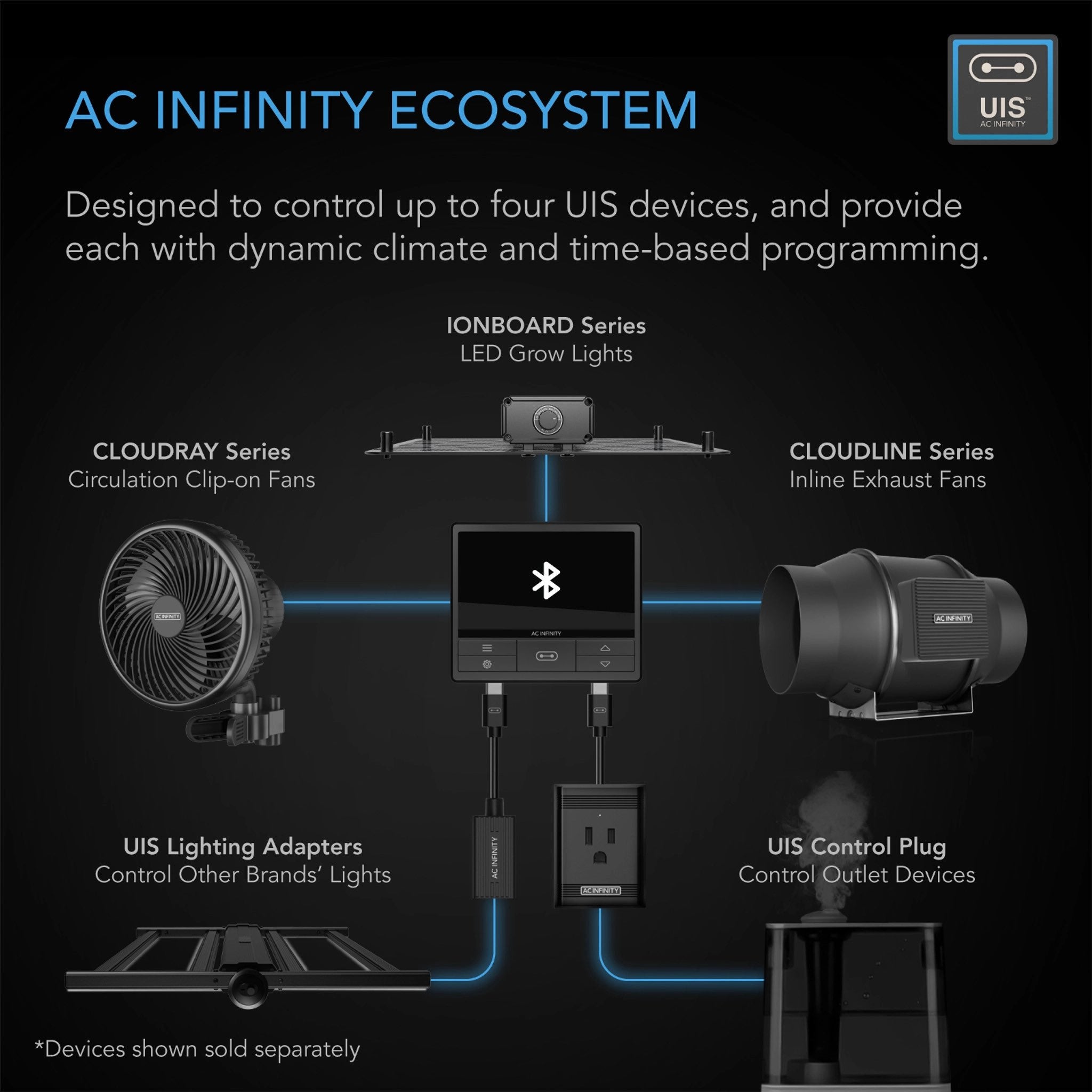
You can add one later. The fan is UIS compatible, so a Controller 69 Pro or Controller AI+ plugs straight into it in place of the 10-speed dial. Buying the T8 up front is cheaper than buying the S8 and a controller separately, so the decision is worth making now if you already know you want automation — but you are not locked out of it.
Can I use it for home ventilation rather than growing?
Yes — large subfloors, roof spaces, workshops and warehouse-scale extraction are all common uses. It is IP44-rated and mounts horizontally or vertically. Every fan ships with an Australian three-pin plug, so it plugs straight into a standard power point. If you want it hard-wired or need a new power point fitted, that part is an electrician's job.
How does the airflow compare with a ceiling or bathroom exhaust fan?
Installers rate exhaust fans in m³/h or L/s. The S8 moves up to 1,456 m³/h (404 L/s) at full speed. For comparison, the National Construction Code minimum for a bathroom or toilet is 25 L/s (90 m³/h), and 40 L/s (144 m³/h) for a kitchen or laundry, discharged outdoors rather than into the roof space. Real airflow drops with every metre of duct, bend and grille, which is where the 746 Pa static pressure rating matters. Check the requirements for your job with your installer.
Can I use a 200 mm fan in a bathroom?
Yes. Most people use the 150 mm for a bathroom, or the 100 mm for smaller rooms such as ensuites and toilets, but several of our customers run the S8 in a medium bathroom. It gives a lot more power in reserve and runs very quietly at low speed, because a larger fan does the same job at a slower speed. What suits your job also depends on the space in the ceiling, the duct route and how much noise you can live with, so if you are unsure, send us the details and we will help. Do not install the fan, controller or power connection directly over a shower or bath, or anywhere it can get water spray.
Is this a genuine AC Infinity unit with Australian warranty?
Yes. Quick Bloom Lights is the official Australian importer and distributor for AC Infinity. Every unit ships with an Australian three-pin plug and a two-year warranty handled here in Sydney — no shipping units overseas and no dealing with an offshore seller if something goes wrong.